
What Is Umami, and Why MSG Got Blamed
What is umami, the savory fifth taste? Here's the science behind it, why one 1968 letter turned MSG into a villain, and how to build it in your own cooking.
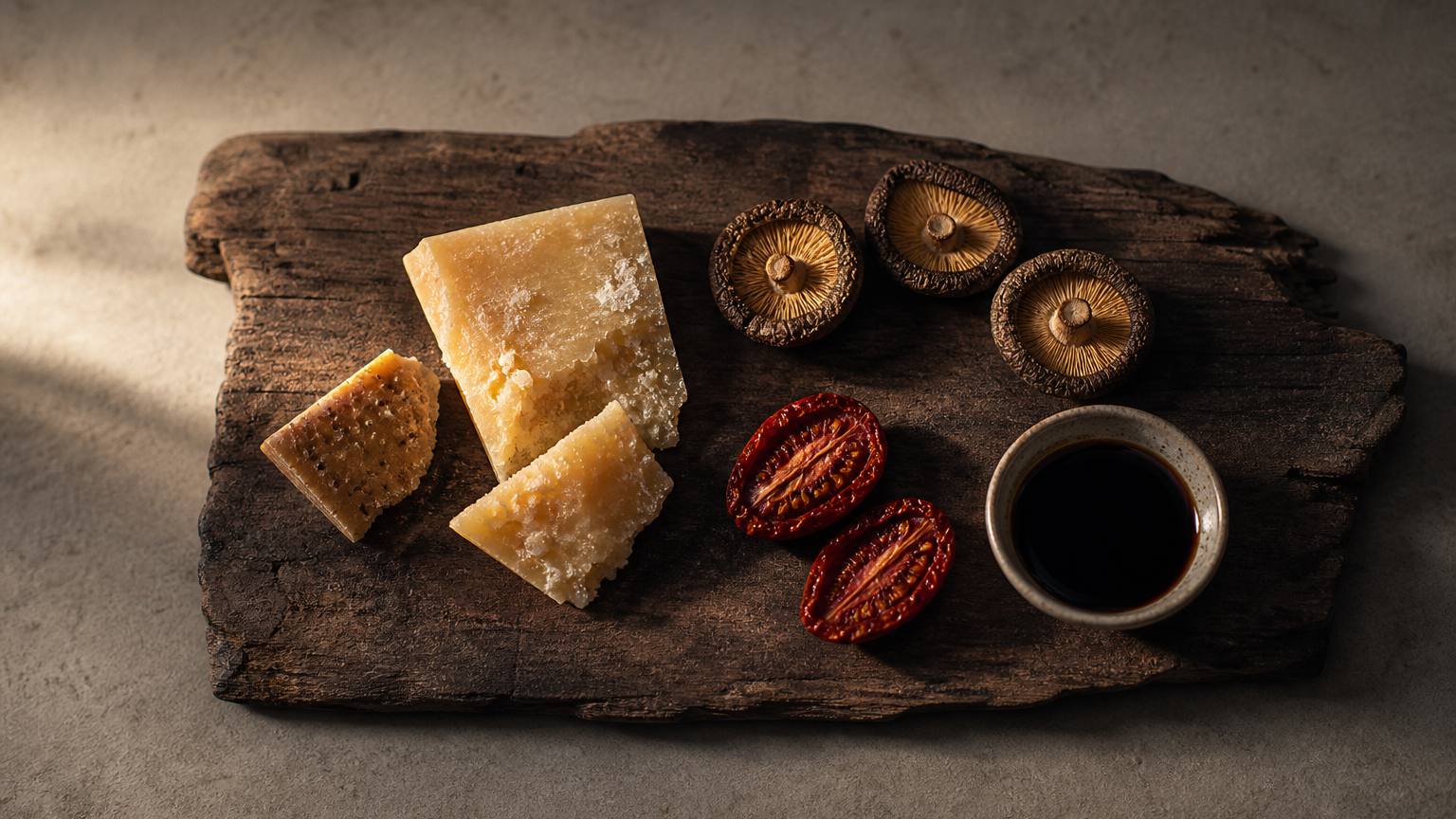
Simmer a pot of tomatoes for an hour and something happens that more salt can't explain. The sauce goes round and deep, and it coats your tongue in a way that lingers after you swallow. That mouth-filling savoriness has a name. So what is umami? It's the fifth basic taste, sitting alongside sweet, salty, sour and bitter, and it comes mostly from one amino acid: glutamate.
It's also the reason a lot of people still avoid a seasoning that turns out to be one of the better-studied ingredients in the pantry.
What is umami, exactly
Glutamate is an amino acid. It's a building block of protein, it's in your body right now, and it's in a lot of what you eat. When it's bound up inside a protein chain, you don't taste it. When it comes loose, you do, and your tongue reads it as savory.
That's why ingredients tend to get more savory as they age, ferment, dry or cook down, though not by a single mechanism. Fermentation and long aging break proteins down enzymatically and release glutamate that was previously bound. Drying mostly removes water, so the free glutamate already present ends up concentrated in less weight, which is why a sun-dried tomato reads far more savory than a fresh one. Parmesan, anchovies, soy sauce, miso, dried shiitake, cured ham and long-simmered stock all end up glutamate-rich, by different routes.
Glutamate also has two partners. Pair it with inosinate (in meat and fish) or with guanylate (in dried mushrooms) and the savoriness reads stronger than either component would on its own. That synergy is why dashi is kombu plus bonito flakes, why a mushroom and beef ragù tastes bigger than either ingredient predicts, and why a little bacon in a pot of beans does more work than its volume suggests.
The taste nobody would accept
In 1908, a chemist named Kikunae Ikeda was eating tofu in kombu broth and became convinced he was tasting something that wasn't sweet, salty, sour or bitter. He took it to the lab. From about 12 kilograms of dried kombu he isolated roughly 30 grams of the compound responsible, and identified it as glutamic acid. He named the taste umami, roughly "savoriness," patented a method for producing it, and worked with the entrepreneur Saburosuke Suzuki to bring it to market as the product that became Ajinomoto. The account of the quantities comes from a history of umami research published in the journal Flavour.
Acceptance came slowly outside Japan. For most of the twentieth century, umami was often treated in Western food science as a curiosity or as some blend of the other four tastes rather than a basic taste of its own. What changed the argument was receptor work in the early 2000s identifying tongue receptors that respond to glutamate. Cooks had been building savoriness for centuries by then, without needing a name for the mechanism.
How one letter built a myth
On 4 April 1968, the New England Journal of Medicine published a short letter from a doctor named Robert Ho Man Kwok, describing numbness and palpitations he noticed after eating at Chinese restaurants in the US. He floated several possible causes, including cooking wine, sodium, and MSG.
MSG is the cause that stuck. Newspapers ran with "Chinese Restaurant Syndrome," a label that tied a loose set of symptoms to one cuisine, and it lasted about fifty years.
The naming is hard to explain on chemistry alone. Parmesan and tomatoes are both glutamate-rich, and no equivalent term ever attached itself to Italian food. That doesn't prove the symptoms were imagined, but it does suggest the suspicion didn't land on Chinese restaurants because of what was in the pan. In May 2020, the Associated Press reported that Merriam-Webster had revised its entry; the dictionary now labels the term dated and sometimes offensive, and notes that research has not established the link. That revision followed a campaign fronted by Asian-American public figures including the restaurateur Eddie Huang, and it was launched and financed by Ajinomoto, which sells MSG. The label change reflects the evidence, and it was also effective corporate PR.
What the safety research found
The US Food and Drug Administration classifies added MSG as "generally recognized as safe." In its questions and answers on MSG, the agency notes that although many people identify as sensitive to it, studies giving those same people MSG or a placebo have not been able to consistently trigger reactions.
The quantities are worth knowing. On the same FDA page, an average adult is estimated to take in about 13 grams of glutamate a day from the protein in ordinary food, alongside roughly 0.55 grams a day of added MSG. The two aren't quite interchangeable: MSG dissolves into sodium and free glutamate, while glutamate in protein has to be released during digestion first. The FDA's point is that the glutamate itself is chemically indistinguishable between the two, and your body ends up processing it the same way.
When the FDA asked an independent scientific group, FASEB, to review the evidence in the 1990s, the report concluded MSG is safe. It also noted that short-term, mild, transient symptoms such as headache, flushing or tingling may occur in some sensitive individuals who consume 3 grams or more of MSG with no food alongside it. The FDA puts a typical serving of a food with added MSG at less than 0.5 grams, and calls consuming more than 3 grams at once without food unlikely.
So the honest version is narrower than either camp usually states it. Blinded studies have not consistently reproduced symptoms under normal eating conditions, and unusually large doses without food may produce brief symptoms in some people who report sensitivity. If you reliably feel unwell after particular meals, that's real, and it's worth working out what's behind it rather than assuming the answer. Note what you ate, roughly how much, and how long afterwards the symptoms started, because that record is genuinely useful to a clinician. Take recurring reactions to a doctor. Anything acute, such as swelling of the face or throat, difficulty breathing, chest pain or fainting, is an urgent-care situation and not something to work through by reading labels.
Building it on purpose
You don't need a jar of MSG to cook with umami, though there's nothing wrong with one. Most kitchens already hold a few concentrated sources, and the technique is to layer two or three rather than lean on one.
- Concentrate what you have. Reduce stock, brown the tomato paste before adding liquid, roast mushrooms until the edges go dark. Some of that is water leaving and some is browning creating new flavor compounds, which is not identical to what aging does, but the direction is the same: more taste in less volume.
- Stack categories. A fermented thing (soy sauce, miso, fish sauce), an aged thing (parmesan rind, cured pork), and a dried thing (shiitake, sun-dried tomato) reinforce each other more than a triple dose of any one.
A parmesan rind dropped into a pot of soup is the cheapest version of this, so keep the rinds in the freezer. Most of these ingredients keep for months, which makes them a good fit for cooking with what you have.
One caution: umami-heavy ingredients are usually salty ingredients, so add the fish sauce or miso before you finish salting, not after. If you want the longer version of that sequencing problem, it's in how to salt food so it tastes right.
Umami is just a fifth thing your tongue can register, and cooks were building it deliberately long before anyone could name the receptor. The odd part of the story isn't the chemistry. It's that one thinly-evidenced letter kept people nervous about it for half a century.
Gourmate plans your week from recipes that build savoriness through ingredients and method, with the quantities worked out for you. Try it free.