How to Cook With What You Have (and Waste Less)
Turn a half-empty fridge into a real dinner. A practical guide to cook with what you have, cut food waste, and skip the extra shopping trip.
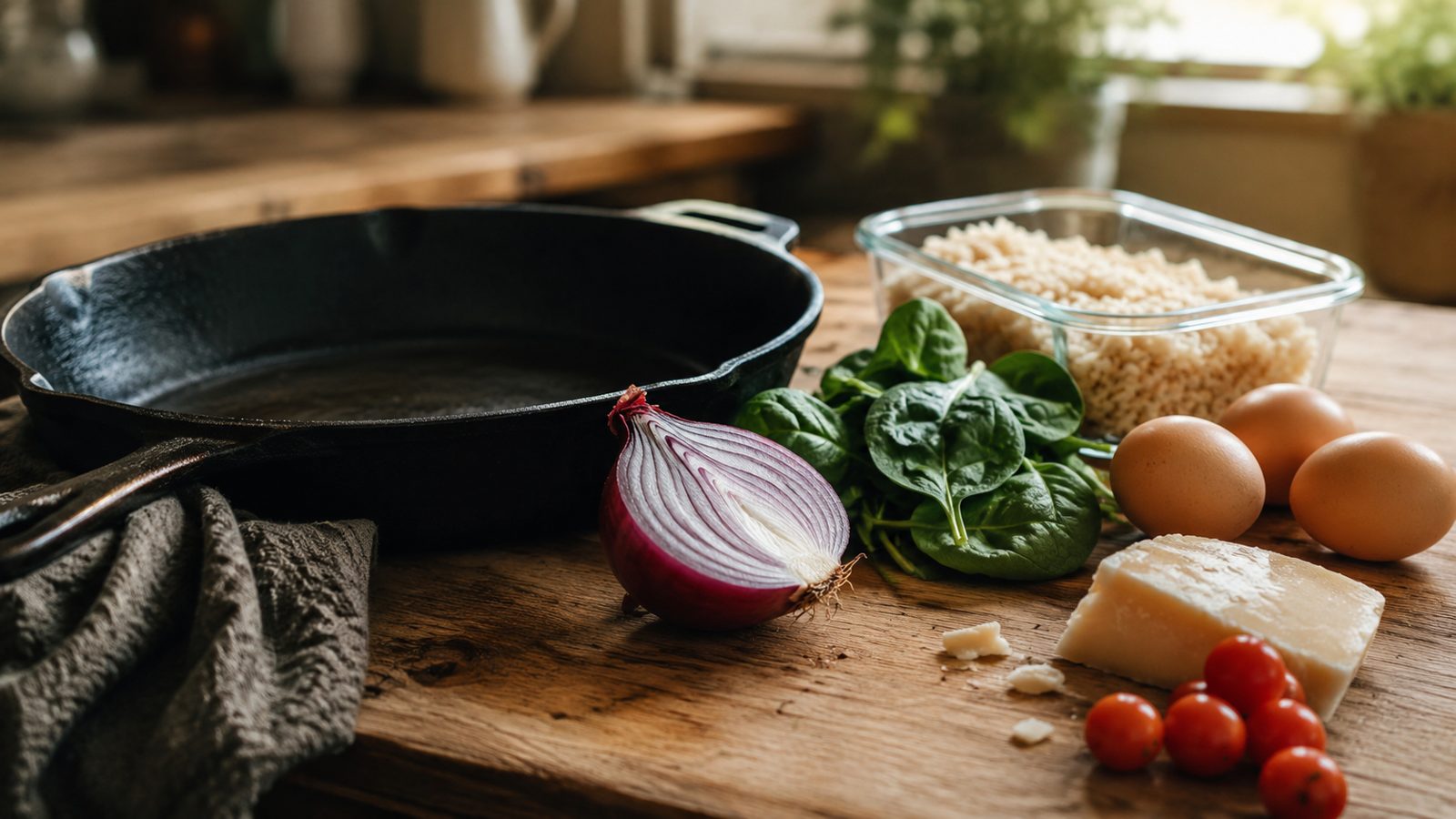
There's half a bag of spinach in the drawer, three eggs, a knob of ginger, and leftover rice from Tuesday. Nothing on that shelf looks like a recipe. So you order in, and by Friday the spinach goes in the bin. Learning to cook with what you have breaks that loop, and it's less about creativity than about a few repeatable habits.
The UN's Food Waste Index Report found that in 2022, 60 percent of the world's food waste happened in households, not in shops or restaurants: roughly a billion meals a day, about 79 kg per person per year. A lot of it looks exactly like that bag of spinach, ordinary food that expired quietly while we cooked something else.
Start with an inventory, not a recipe
The standard cooking workflow runs backwards for this problem. You pick a recipe, write a list, buy the ingredients, cook. Whatever was already in the fridge never enters the equation, which is exactly how it ends up as waste.
Flip the order. Before you think about dinner, spend two minutes actually looking: fridge, freezer, the vegetable drawer you avoid eye contact with. Note what needs to go first. Wilting herbs, open packages, and cooked leftovers jump the queue.
One caution while you're in there: "best before" and "use by" are different labels. "Use by" is a safety deadline, so respect it. "Best before" is a quality estimate, and food past that date is often still fine to eat. Gallup's survey work suggests that people who treat every printed date as a hard deadline waste more food than those who also check the food itself. When you're unsure, err on the side of caution, especially with higher-risk foods like raw meat, fish, and cooked rice.
Learn formulas, not more recipes
A printed recipe expects you to shop for it. When your ingredients are random, what helps more is a small set of forgiving formulas that can take almost anything:
- Fried rice: day-old rice, any vegetable cut small, any protein, soy sauce, a fried egg on top if you have one.
- Frittata: eggs plus whatever vegetables and cheese are lingering. Ten minutes in a pan, five under the grill.
- A blended soup: onion or leek, one main vegetable past its prime, stock, simmer, blend.
- A grain bowl: any grain, any roasted vegetable, something creamy, something acidic.
Those four absorb a surprising share of half-empty fridges, and the exact amounts are flexible in a way a printed recipe never admits. Once fried rice is a pattern in your head instead of a page in a book, the leftover rice and the lonely carrot stop being clutter and start being Tuesday's dinner.
Match the dish to what expires first
A habit worth stealing: cook in order of perishability, not preference. Fresh fish and delicate greens tonight, sturdy roots and cabbage later in the week, frozen and tinned things whenever.
It sounds obvious, but it cuts against how most of us actually pick dinner. We cook what we feel like, and what we feel like is rarely "the mushrooms that are two days from slimy." Planning the week loosely around expiry order means the perishable things get used while they're still good, which is where a lot of fridge waste begins. If you want a fuller system, our guide to building a healthy weekly menu shows how to plan a week in under ten minutes.
Batch cooking helps here too, with one honest caveat: leftovers only save food if someone eats them. The same Gallup research points to uneaten leftovers as one of the biggest single sources of household waste. If your family won't eat the same dish twice, cook smaller amounts instead.
Apps that help you cook with what you have
There's a whole category of tools for exactly this problem. As of July 2026, SuperCook matches your typed-in ingredient list against millions of recipes from around the web, and Samsung Food tracks a pantry alongside its meal planner. Both are capable tools, and both assume you'll keep that ingredient list current yourself.
In practice, manual entry is the step that gets skipped. Gourmate (that's us) approaches it from the photo side: point your camera at the fridge or a pantry shelf, and the pantry scan identifies the ingredients it can see and saves them to your pantry. Those items are then used as constraints when you generate a recipe, so the suggestion is built around what's actually in your kitchen. And because recipes are generated on demand across more than 30 cuisines, an awkward combination like "spinach, eggs, ginger, leftover rice" comes back as a dish designed around those items, not the closest match from a fixed database. You can read more about how that works in how Gourmate's recipe discovery works.
No app replaces the two-minute fridge look, though. The tools shorten the distance between "random ingredients" and "dinner idea," but the habit of checking before shopping is still yours to build.
Make the shop fit the fridge, not the other way around
The last habit is the least glamorous and probably the most effective: write the shopping list after the inventory, never before. Every item already in the fridge is an item that doesn't go on the list, and buying less is the surest way to waste less.
A decent rule of thumb for the transition week: plan two meals entirely from what you already own before you buy anything new. You'll probably find more dinners in there than you expect. And the first time a "there's nothing to eat" fridge turns into an actual meal, the habit tends to stick.
Gourmate turns the ingredients you already have into recipes worth cooking. Scan your pantry, set your preferences once, and get dinner ideas built around your fridge.