What Freezes Well, and What Really Doesn't
A practical guide to what freezes well and what just turns to mush, plus safe thawing and how to use your freezer as a real meal-planning tool.
Open most freezers and somewhere near the back there's a bag you can't identify. Something beige, frosted over, cooked with good intentions a few months ago. The freezer is where a lot of food goes to be forgotten, which is a shame, because used properly it's the closest thing a home kitchen has to a pause button.
Knowing what freezes well is half the skill. The short version: soups, stews, cooked grains, bread, and most raw meat and fish come back well. Foods that are mostly water and eaten raw or crisp, like lettuce, cucumber, and whole tomatoes, do not. The rest of this is the why, plus how to thaw all of it without making yourself ill or wrecking the texture.
What freezing actually does
A frozen dinner isn't a fresh one waiting patiently. Freezing to 0°F (-18°C) puts bacteria, yeasts, and molds into a kind of dormancy, and the USDA's guidance on freezing is clear that this pauses those microbes rather than killing them. Food held steadily at 0°F stays safe more or less indefinitely. The safety holds, but the quality slips: flavour fades, textures soften, and the surface dries into freezer burn.
A few habits follow from that. Freeze food while it's still good, ideally before it starts to turn, since a stew frozen at its peak thaws better than one you were already side-eyeing. Cool cooked food quickly first, spread into shallow containers rather than leaving a hot stockpot to cool whole, so it chills fast and doesn't warm everything around it. And label everything with what it is and the date. For quality rather than safety, most cooked dishes are best eaten within a few months, and the mystery bag at the back is usually a labelling problem more than a freezer one.
What freezes well, and why
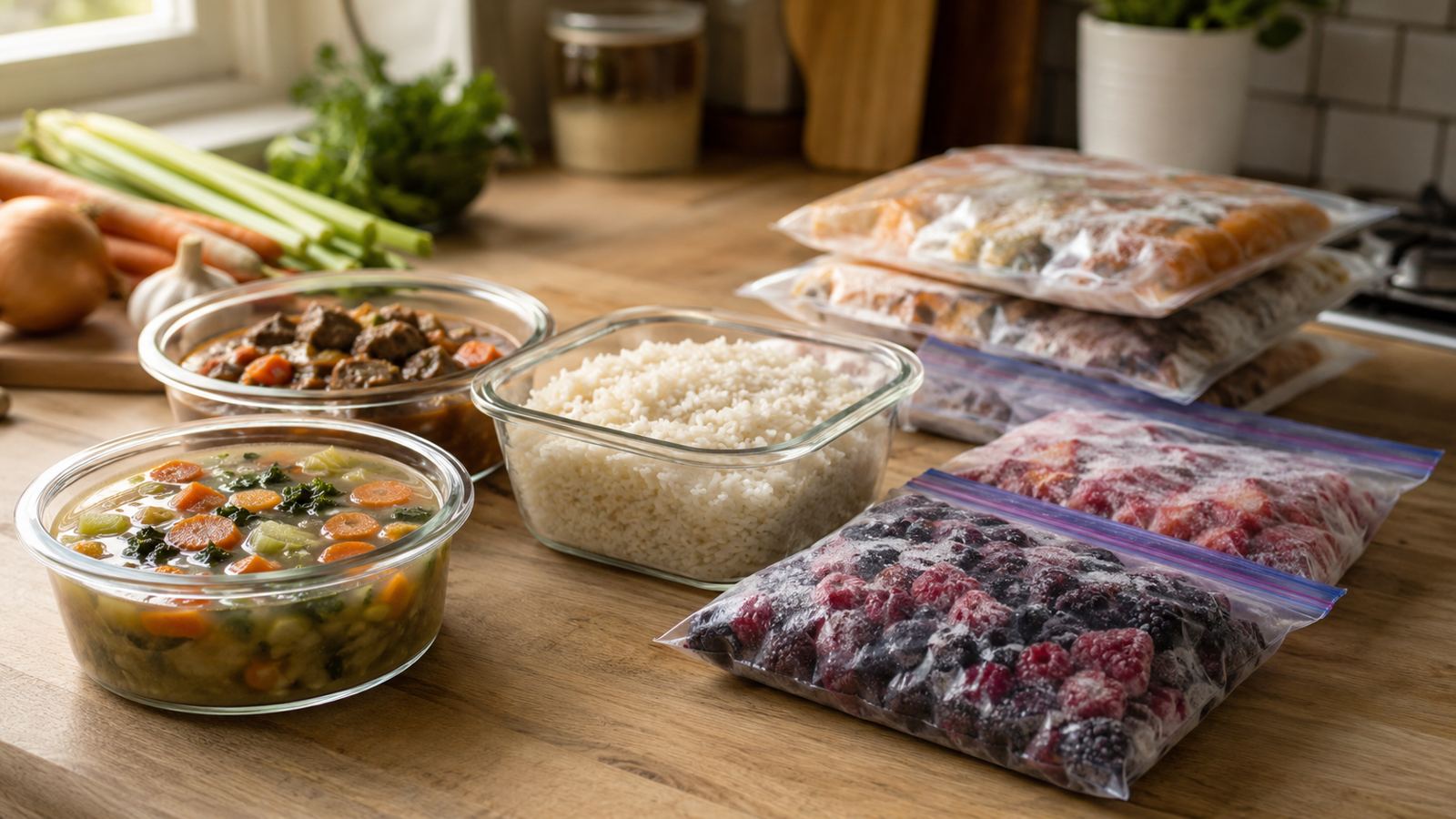
The dishes that survive a freeze best are the ones where texture is already soft or where fat protects the structure. Soups, stews, chilli, curries, and cooked beans freeze beautifully, because they were never crisp to begin with. Cooked grains like rice and cooked pasta freeze well when they're going straight into a soup or a bake later. Bread, cooked meat, raw meat and fish, stock, and most baked goods all hold up.
Raw vegetables freeze better after a quick blanch, a short dip in boiling water followed by an ice bath. Blanching slows the enzymes that keep aging vegetables even in the cold, so they hold their colour and texture instead of turning drab in the bag. Berries and sliced fruit freeze well spread on a tray first, then bagged once solid so they don't clump.
Dishes that are already soft and saucy tend to survive best of all. A ragu, a coconut curry, a well-buttered mash: there's little crisp texture left to lose, so they come back close to how they went in.
What turns to mush
The failures follow one rule. When water inside food freezes, it forms sharp ice crystals that puncture cell walls, and on thawing the structure collapses into something soft and weepy. Anything you value for its crunch is at risk.
The National Center for Home Food Preservation keeps a useful list of foods that don't freeze well, and the pattern is consistent:
- High-water raw vegetables: lettuce, cucumber, celery, and raw tomatoes thaw limp and watery. Fine for a future soup or sauce, useless for a salad.
- Cream-based and egg-based sauces: plain cream, custards, and mayonnaise tend to split and curdle as the emulsion breaks. A sauce thickened with flour or plenty of fat holds together better.
- Cooked plain potatoes: cubes and slices tend to turn grainy and watery. Mashed potato with enough butter and cream holds up better, since the starch cells are already broken down.
None of this makes those foods truly unfreezable. It changes what they're good for afterwards. Frozen whole tomatoes are hopeless in a salad and excellent in a sauce, where the softness is the point.
Freeze in portions you'll actually use
One of the most useful freezer habits has nothing to do with the food and everything to do with the container. Freeze in single meal-sized portions rather than one giant block. A litre of soup frozen solid is slow to thaw and an awkward amount to reheat. Frozen in single or double portions, it defrosts in the fridge overnight, or goes straight from freezer to pan, and you take out only what you need.
Flat beats deep. Soup or sauce frozen flat in a labelled bag stacks like files and thaws faster than a deep tub. Leave a little headspace, because liquids expand as they freeze.
This is where a bit of planning pays off. If you're already cooking a batch, scaling the recipe up so half goes to the freezer costs almost no extra effort, a point our guide to batch cooking without getting bored makes about cooking components. Apps that let you set the number of servings, Gourmate among them, handle the scaling for you, so the surplus comes out portioned from the start.
Thawing is where people get it wrong
Freezing is the easy part. Thawing is where good food can turn risky. The USDA's defrosting guidance lists three safe methods, and leaving food out on the counter is not one of them. As frozen food warms, its outer layer can sit in the temperature range where bacteria multiply long before the middle has thawed.
The three safe routes are the fridge, cold water, and the microwave. The fridge is slowest but the most forgiving: most items need a day, larger ones longer, and the food stays cold the whole time. Cold-water thawing is faster if you seal the food in a leakproof bag and change the water every 30 minutes. Microwave thawing is fastest but leaves warm spots, so cook that food straight away. Many soups and stews skip thawing altogether and reheat straight from frozen.
Refreezing depends on how you thawed. Food thawed in the fridge can go back in the freezer, with some quality lost each round. Food thawed in cold water or the microwave should be cooked before it's refrozen. Take extra care with the higher-risk foods, raw meat, fish, and anything with dairy or cooked rice folded in, and reheat leftovers until they're steaming hot all the way through. If you're managing a serious allergy, freezing and thawing don't change what's in the dish, so keep checking labels and ingredients as you normally would.
Build the freezer into your week
Used this way, the freezer smooths out the bad nights. A couple of labelled portions of something you actually like beats another takeaway, and it's the payoff for cooking a little extra on a good day. When the fridge is looking thin, a portion from the freezer plus whatever needs using up is often a whole dinner, which is where our guide to cooking with what you have picks up. The freezer won't buy you more food. It helps you waste less of what you already bought.
Gourmate scales recipes to the portions you need and drafts a week around your tastes and what's already in your kitchen, so cooking extra for the freezer takes no extra planning.