
Batch Cooking Without Getting Bored by Thursday
Batch cooking fails when every container holds the same meal. Cook components instead, store them safely, and eat a different dinner every night.
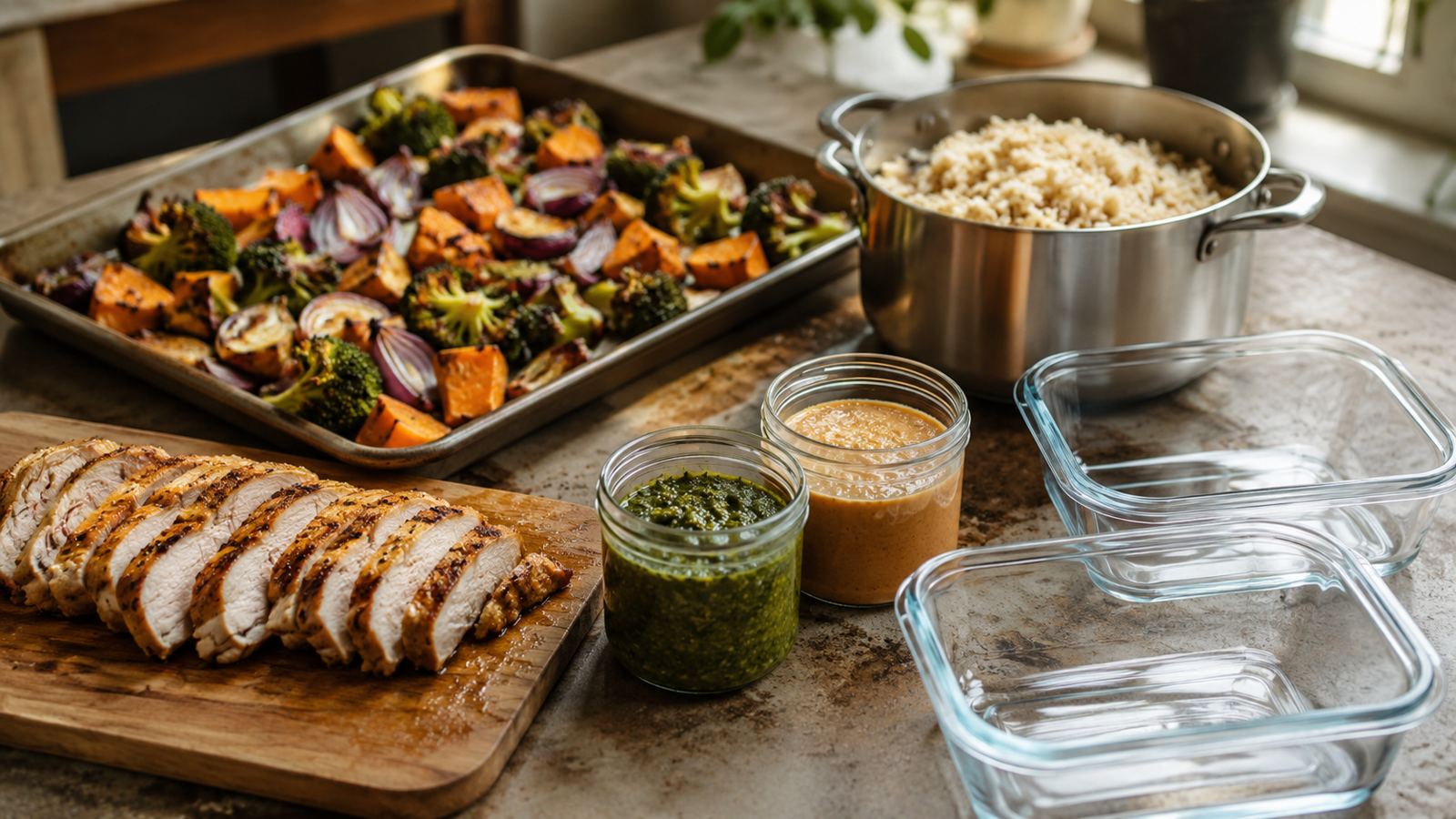
The classic batch cooking story goes like this. Sunday afternoon, three hours at the stove, six containers of turkey chili lined up in the fridge like a promise. Monday it tastes great. Tuesday it's fine. Wednesday you're staring at container number four and ordering a pizza, and the last two go in the bin on Saturday.
The problem isn't batch cooking, and it isn't your willpower either. The plan was wrong. You didn't cook a week of food, you cooked one dinner six times.
Why week two never happens
Food researchers have a term that gets close to the Wednesday wall: sensory-specific satiety. Barbara Rolls and colleagues showed in the early 1980s that the pleasantness of a specific food drops as you eat it, while other foods stay appealing. In one of the classic experiments, people served a four-course meal with variety ate 44 percent more overall than people served the same food four times in a row.
The research measures that effect within a single meal, so it doesn't prove anything about day four of chili week. But the direction of the finding matches what most batch cooks experience: the dish doesn't get worse, your appetite for that exact combination of flavours wears down.
Boredom isn't the only reason people quit meal prep. Storage, cost, and unrealistic recipes all play their part. It is the most fixable reason though, because the fix isn't more discipline. It's a different way to structure the same three hours.
Cook components, not five identical dinners
The fix is to stop batching finished meals and start batching building blocks. Instead of one big recipe multiplied by six, you cook a small set of neutral components that combine into different dinners all week:
- A base or two: a pot of rice or another grain, roast potatoes, or cooked noodles
- One or two proteins: a tray of roast chicken thighs, a pan of seasoned lentils, marinated baked tofu
- Vegetables in bulk: two trays of whatever roasts well that season, plus something raw and crunchy
- Two sauces that don't taste alike: say, a herby chimichurri and a peanut sauce
The sauces are the part I'd argue matters most. The same chicken and roasted vegetables become a noticeably different dinner under chimichurri than under peanut sauce with lime. Monday the chicken goes into tacos, Tuesday it tops a grain bowl, Thursday it lands in a quick soup with the leftover rice. The ingredients repeat; the dinners don't feel like they do.
Components also fail more gracefully. When a finished casserole turns out mediocre, you own six portions of mediocre. When one sauce disappoints, you swap it and the rest of the week is untouched.
A batch cooking plan for a normal week
You don't need a four-hour Sunday marathon. One format that works with a standard oven and a normal kitchen: a roughly two-hour block, sequenced around the oven. Trays go in first, protein on one, vegetables on the other. While those roast, a grain simmers on the hob and you blitz the two sauces.
Then plan only three or four dinners from the batch, not seven. A full week of pre-decided meals leaves no room for the Wednesday you eat out or the Friday you want something fresh, and unused portions are how batch cooking turns into food waste. Our guide to building a healthy weekly menu makes the same point about wild-card slots: a plan with no slack doesn't bend, it breaks.
Cooked too much anyway? Freeze half the protein the same evening, before it ever hits the fridge, and next week starts with dinner already half done.
The fridge rules that matter more than the recipe
Batch cooking means eating food that was cooked days ago, so the storage rules are part of the recipe, not an afterthought.
The USDA's guidance on leftovers is specific: cooked food should be refrigerated within two hours of cooking, keeps for three to four days in the fridge, and should be frozen if you won't eat it in that window. That three-to-four-day limit is a safety line, not a quality suggestion, and food can carry enough bacteria to make you ill without smelling or looking off. Cook on Sunday and the fridge portions need eating by Wednesday or Thursday; everything meant for later belongs in the freezer from day one.
Cool food fast by spreading it into shallow containers rather than leaving the whole stockpot to cool on the hob. And reheat leftovers until they're steaming hot all the way through, 74°C (165°F) if you use a thermometer.
Rice needs its own mention, because it's a batch-cooking staple that's easy to get wrong. Raw rice can carry Bacillus cereus spores that survive cooking and multiply as cooked rice sits at room temperature. Get rice into the fridge within two hours of cooking, never leave it out overnight, and hold the three-to-four-day window strictly, counting the cooking day. Cooked pasta and other grains deserve the same treatment, and so do the higher-risk proteins: cooked meat, fish, and anything with dairy folded in.
The shopping maths changes too
Component cooking changes your shopping list: you're buying for six portions of chicken and two jars of sauce, not one recipe's worth, and the quantities need scaling to match.
Apps can take over that arithmetic. In Gourmate, recipes have a servings picker, so you can generate a recipe for two, then scale it to six and the ingredient amounts update with it. Planned recipes feed into a single shopping list grouped by category, which makes the bigger component shop easier to work through in one pass. And if your batch plan should start from what's already in the kitchen, our guide to cooking with what you have covers that end of the problem.
Start smaller than you think
One protein, one grain, one sauce, one tray of vegetables. That's a perfectly good first batch, and for simple recipes it fits inside an evening rather than an afternoon. If the week goes well, add the second sauce next Sunday. A batch habit survives when it fits your actual weekend, not the aspirational version with twelve matching glass containers.
Done as components, batch cooking stops being a test of your tolerance for repetition and goes back to being what it promised: most of the week's cooking, done while you were already in the kitchen anyway.
Gourmate scales recipes to the portions you need and merges your weekly plan into one categorised shopping list. Set your preferences once and let it draft your week.