
How to Scale a Recipe Up or Down Without Ruining It
Doubling dinner or cooking for one? How to scale a recipe without mushy rice, a salty stew, or a sunken cake, and where the math alone won't save you.
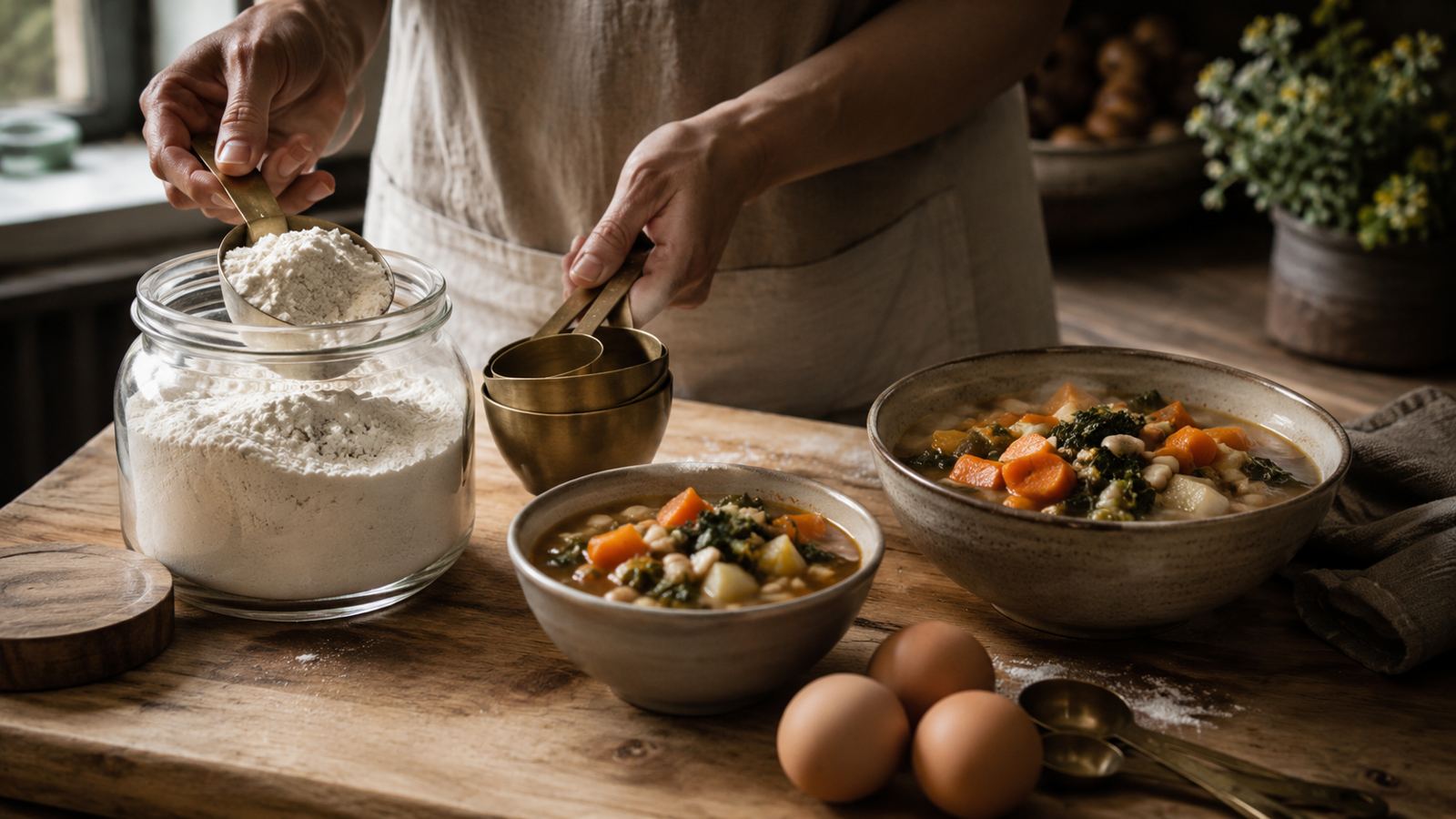
The recipe serves four. There are two of you, and one of you refuses to eat the same curry three nights running. So you halve everything at the counter, lose track somewhere around the coconut milk, and end up with a sauce that tastes like it's missing something. It is: half your attention went into the arithmetic.
Learning how to scale a recipe properly fixes most of this. The core move is simple. Divide the servings you want by the servings the recipe makes, and multiply every ingredient by that number. Four servings down to two is a factor of 0.5. Four up to ten is 2.5. That part takes thirty seconds with a calculator. The interesting problems start after the math is done, because salt, leavening, and your biggest pot don't follow the same rules as flour.
Start with the conversion factor
Write the scaled amounts down before you touch a single ingredient. Every cook who has doubled a recipe from memory has also forgotten, mid-recipe, whether the tablespoon of tomato paste already went in twice. A written list, or an app that rewrites the quantities for you, removes the memory game entirely.
Awkward numbers need a decision before you start cooking, not during. Half of three eggs is a real question with a practical answer: whisk the third egg, weigh it, and use half by weight. Half of 1/3 cup is 2 tablespoons plus 2 teaspoons. If a scaled amount comes out plainly silly, like 0.75 of a garlic clove, round toward flavor and move on.
Weight beats volume the moment you scale anything. Multiplying 240 grams of flour by 1.5 gives you a clean 360 grams. Multiplying "2 cups, scooped" by 1.5 multiplies the scooping error too.
The seasoning trap when you scale a recipe
Seasoning is where straight multiplication most often overshoots. A doubled pot doesn't cook like the original: it simmers longer, evaporates a smaller share of its liquid, and its salty ingredients (stock, canned tomatoes, cheese) bring their own sodium along. Double the added salt on top of all that and you can land well past where the original recipe sat.
The working rule that KitchenAid's scaling guide gives is to double everything except herbs and spices, increase those by half, then taste and adjust upward. The same logic applies to chili flakes, hot sauce, and anything else where "slightly too much" ruins the dish. Adding more at the end is easy; rescuing an oversalted pot is not.
Going down, the same caution applies in reverse. When you halve a dish, start with a little less than half the seasoning and correct at the end, when there's less liquid left to dilute a mistake.
Baking is chemistry before it's cooking
A stew forgives. A cake does not. Baking recipes are balanced systems where leavening, structure, and moisture are tuned to a specific batter depth and pan, which is why doubling one into a single big pan so often produces a dense middle or a sunken crown.
The safest pattern comes from America's Test Kitchen: for things baked as one unit, like cakes, pies, and quick breads, mix the doubled batch if you like, but bake it in two pans of the original size so the stated time and temperature still apply. Individually portioned bakes are the exception. Cookies, muffins, and biscuits scale happily, because the oven only ever sees one cookie at a time.
Halving a bake, KitchenAid's guide suggests checking for doneness about 20 percent sooner than the original time, and trusting the tester over the clock.
Rice, beans, and the evaporation problem
Some ingredients fail at scaling for a purely physical reason: evaporation depends on the surface area of your pot, not on how much is in it.
Stovetop rice is the classic case. The water in a rice recipe covers two jobs, absorption plus whatever steams off the top. Absorption doubles when the rice doubles. Evaporation doesn't, because the pot opening stayed the same size. That extra unevaporated water is why America's Test Kitchen advises against straight-doubling absorption-method grains, and their test cooks make the same point about beans: a doubled batch has twice the liquid over the same surface area, so it needs more time to reduce.
The practical fix for rice is to skip the multiplication and follow the package ratio for the new quantity, or switch to the pasta method (boil in plenty of water, drain), which sidesteps the evaporation math entirely.
Your pot changes the timing
Doubled recipes don't take double the time, but they rarely take the original time either. A deeper pot heats through more slowly. A crowded frying pan drops in temperature and steams food that was supposed to brown, so scaled-up searing usually means cooking in batches rather than piling the pan higher.
Trust what the food looks like over what the clock says. Recipes give times for one specific quantity in one specific vessel; the visual cue ("simmer until thickened", "golden at the edges") is the part that survives scaling. When scaling up, start checking at the original stated time and then every five minutes; when scaling down, start checking well before it.
One more check before you commit to 2.5x: confirm the sauce actually fits in your largest pot, with room left to stir.
Make the arithmetic someone else's job
The judgment calls above stay with you. The multiplication doesn't have to. In Gourmate, every recipe has a servings picker that goes from half a serving up to six, and picking a number rescales each ingredient quantity instantly. Set your household size once and every generated plan and weekly menu comes out sized for your table, grocery list included, and a one-tap toggle converts the whole recipe between metric and imperial.
What an app can't do is taste your stew, so the final seasoning adjustment still happens at the pot. And if you're scaling up on purpose to cook once and eat twice, it pays to do it in a way that doesn't bore you by Thursday.
Cooking for one, two, or a full table? Gourmate scales every recipe to your servings, in your units. Try it at gourmate.ai.