
Meal Planning for Picky Eaters (Without Cooking Twice)
Meal planning for picky eaters usually ends in two dinners or three safe meals on repeat. How to cook once for a table that can't agree on anything.
One person at your table treats mushrooms as a personal insult. The four-year-old who happily ate broccoli last month now sorts it to the edge of the plate like it's contaminated. Your partner is easing off carbs, and you'd like to cook exactly once tonight. Meal planning for picky eaters gets framed as a toddler problem, but most households run on some version of it: several sets of preferences, one stove, one cook.
The usual outcomes are both bad. Either you turn into a short-order cook producing two or three dinners a night, or the menu shrinks to the handful of meals nobody objects to, served on a loop until the cook is the one who can't face dinner.
There's a middle path, and it takes less work than cooking twice.
Why the same dinner splits the table
Start with the kids, because that's where the research is. Rejecting new foods is a normal developmental phase, not a character flaw, and it's common. In a longitudinal study that followed children from age 2 to 11, between 13 and 22 percent were reported by their mothers as picky eaters at every age the researchers checked. New picky eaters kept appearing throughout childhood, and for about 40 percent of the children identified, the phase lasted more than two years.
If picky eating regularly persists for years, a meal plan that only works once everyone eats normally isn't a plan. You need one that works while the pickiness is still in the room.
Adult pickiness is studied far less, but anyone who cooks for adults knows the shape of it: quieter, firmer, and not going anywhere. Someone who has ordered around cilantro for twenty years isn't in a phase. A workable family menu treats those preferences as fixed inputs, not problems to be solved at the table.
What the research says about picky eaters
The best-supported tool is repeated, low-pressure exposure. The CDC's guidance for parents puts it plainly: a child may need to see a new food 8 to 10 times before they're willing to try it, and other guidance runs higher still. That is far more offers than most of us have patience for, which is exactly why knowing the number helps. Offer number six isn't failing. It's halfway.
Two details matter as much as the count. The exposures should be neutral, meaning the food shows up on the table without commentary, bribes, or a staring contest. And an exposure doesn't require eating; looking at, touching, or ignoring the food all count as contact. The feeding model many dietitians work from, Ellyn Satter's division of responsibility, draws the line the same way: the cook decides what's served and when, the eater decides whether and how much.
For meal planning, the practical version is this: new foods belong next to familiar ones, in small amounts, repeatedly, and nobody comments on whether they get eaten.
One boundary worth naming: this advice covers ordinary pickiness. If a child eats from a very short list of foods, is losing weight or falling off their growth curve, or panics around new food, that's a different situation, and a pediatrician or feeding specialist is the right next step, not a better meal plan.
Serve the parts, not the verdict
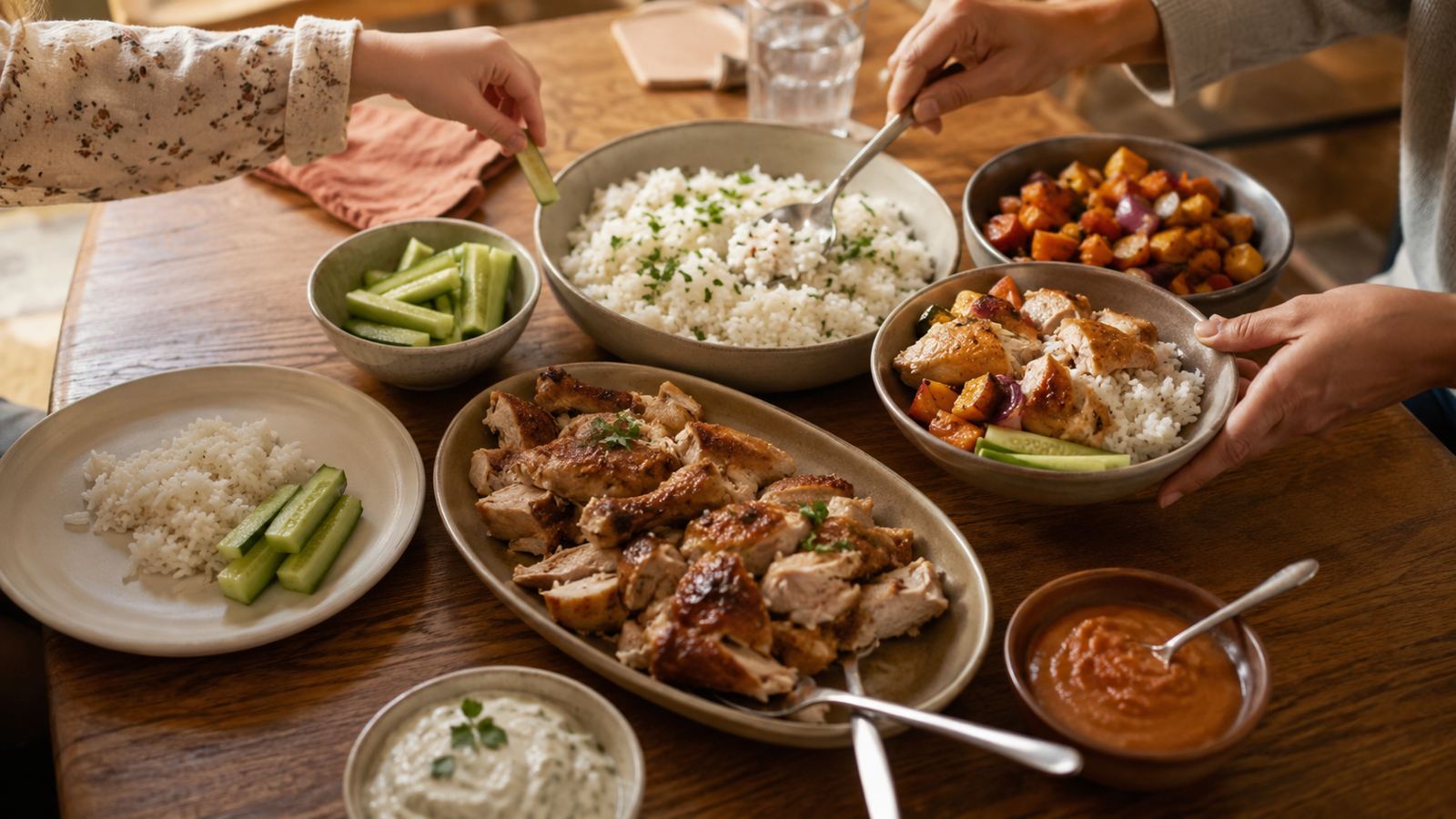
The most useful structural change is to stop serving finished plates and start serving components. Taco night already works this way: a stack of tortillas, bowls of fillings, everyone assembles their own, and the pickiest person at the table quietly builds a cheese taco without anyone having to approve it. Extend that logic to the rest of the week: a base, a protein, a vegetable or two, and a sauce, each in its own dish in the middle of the table.
The picky eater builds a plain plate of rice, chicken, and cucumber. Everyone else adds the roasted peppers and the sauce with heat in it. One shopping list, one set of pans, one cooking session, several different dinners at the table. Keeping sauces on the side helps more than it looks like it should; for plenty of eaters, kids especially, the objection isn't the ingredient, it's things touching.
Two habits make the format work. Every meal includes at least one item the pickiest person reliably eats, so nobody sits in front of a plate with nothing on it. And the new or contested food appears as one small dish among several, not as the centrepiece it would be rude to refuse. If you already batch-cook, this is the same idea as cooking components instead of finished meals, just applied at the table instead of the fridge.
Plan the week around the overlap
Before planning another week, write the constraints down properly, in three tiers. Allergies and intolerances are hard lines and belong at the top; a shellfish allergy isn't a preference, and no amount of exposure therapy applies to it. Diets come second: vegetarian, low carb, whatever shapes the structure of a plate. Genuine dislikes come last, and they're the only tier with any flex in it.
The overlap is usually bigger than the three meals a household has been rotating. A tray-bake the low-carb eater takes without the potatoes, a pasta that works with the sauce served separately, a curry where the heat gets added per bowl. Collect eight or ten of those and weekly planning turns into picking from a list, with room left for one wildcard slot where something new rides along next to a reliable favourite. The approach in our guide to building a healthy weekly menu works unchanged here; the overlap list just becomes your ingredient pool.
The wildcard slot is also where the exposure advice gets applied. One new vegetable, roasted on the same tray as the familiar ones, week after week, costs almost nothing to offer and keeps the repeated-exposure clock running without turning dinner into a project.
Where an app earns its keep
Keeping one person's allergy, another's diet, and a third person's mushroom embargo in your head every time you plan is exactly the kind of bookkeeping software is for. The apps in our meal planning app comparison handle it to different degrees. As of July 2026, Samsung Food lets you set diets and flag avoidances and dislikes in your settings, and Mealime filters its recipe collection around a single shared profile of allergies and dislikes. That shared-profile setup works well when the household eats one way, and gets thin when the constraints belong to different people.
Gourmate approaches it from the generation side. Because recipes are written on demand rather than filtered out of a fixed catalogue, adding constraints doesn't shrink a library of options. You set your allergens once from a preset list, pick a diet type from keto to vegan, type free-text dislikes like cilantro or blue cheese, and tell it your household size. Generated recipes are built with all of those applied at the same time, and a taste profile learns from your ratings, so suggestions move toward what your table actually eats. For a serious allergy, keep doing what you already do and check the ingredient list yourself; no app replaces that habit.
None of this makes a four-year-old eat broccoli. It just takes the remembering and the cross-checking off the cook's plate, which on a Tuesday evening is worth a lot.
One table, one dinner
The goal isn't converting anyone. Some people will hate mushrooms at eighty, and dinner will have been fine. The goal is a week where the cook cooks once, the pickiest plate always has something on it, and new foods keep showing up in small, ignorable amounts until one Tuesday somebody eats the broccoli and nobody makes it weird.
Gourmate generates recipes around your household's allergens, diets, and dislikes, sized to the number of people at your table. Set the constraints once and plan the week from the overlap.