
Okonomiyaki: Japan's Savory Cabbage Pancake
Okonomiyaki is Osaka's cabbage pancake: a dashi batter, pork belly laid on top, and one nervy flip. Here's the recipe, the technique and the allergens.
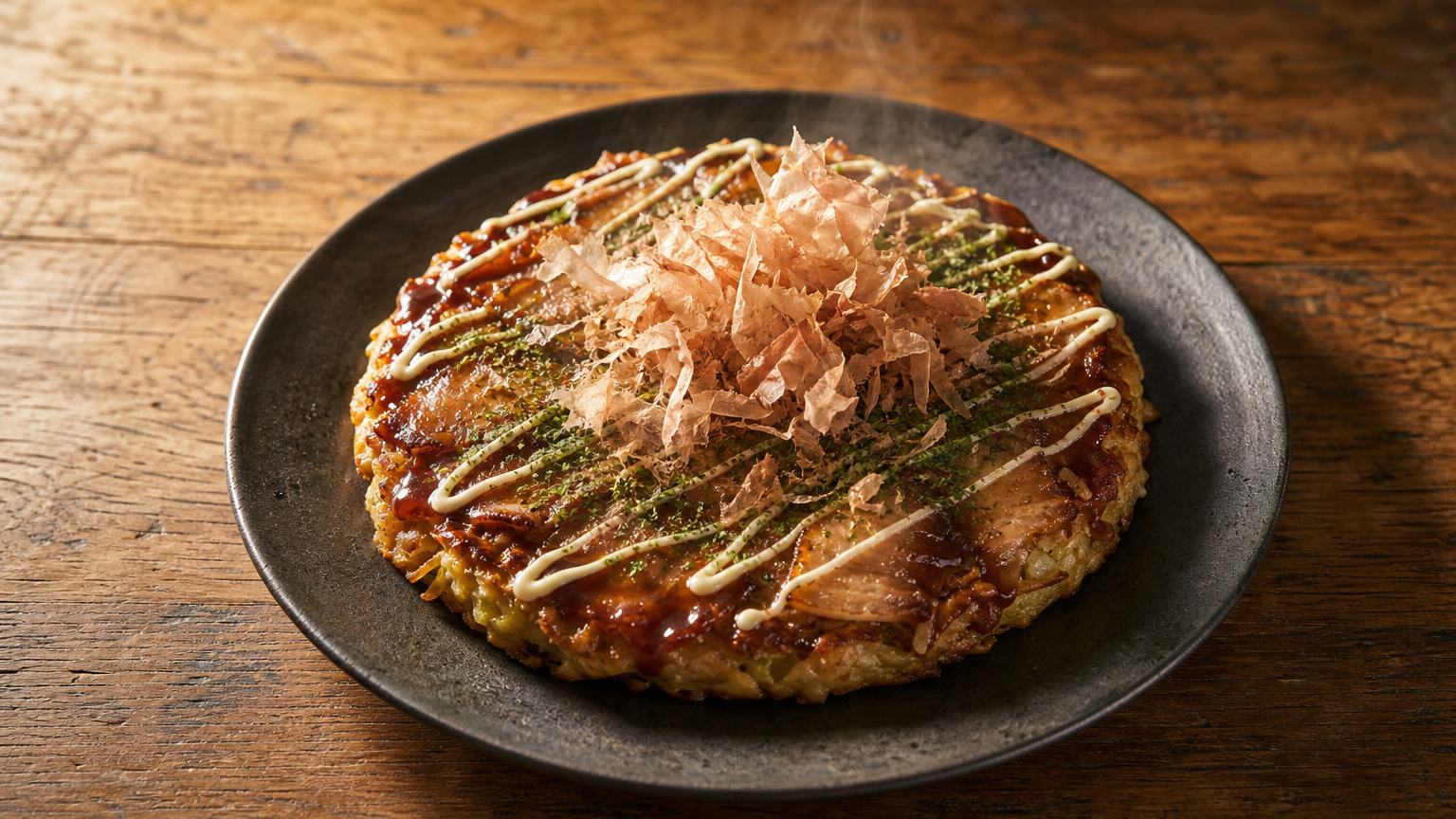
A quarter of a small cabbage, shredded fine, looks like far too much for one pancake, and in the bowl it looks worse: a heap of green with barely enough batter to coat it. That ratio is what defines okonomiyaki, Osaka's savory cabbage pancake. The version below serves two and runs about 30 minutes.
What okonomiyaki actually is
The name means roughly "grilled as you like it," which tells you how loose the format is. Today's dish took shape in the twentieth century, though Nippon.com traces the lineage back to a sixteenth century flour-and-water pancake called funoyaki.
Two regional styles are the best known. Kansai style, which Osaka is known for and which this recipe follows, mixes everything into a batter of flour and kombu dashi before it hits the pan. Hiroshima style layers instead, and finishes with fried noodles and egg. The same source cites the Oconomiyaki Academy counting more than 16,000 okonomiyaki restaurants across Japan, so no one recipe is definitive.
The recipe, top to bottom
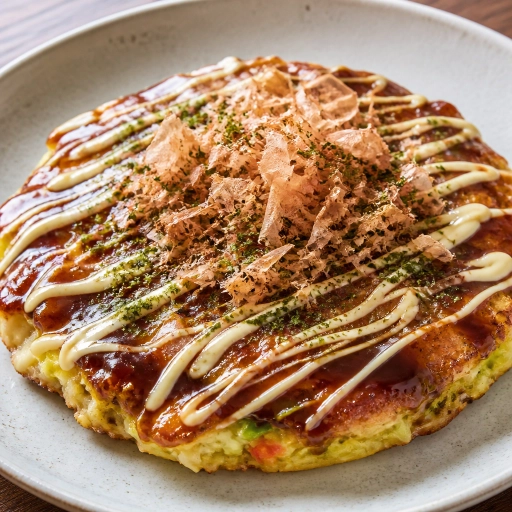
Okonomiyaki
Okonomiyaki is a crisp-edged, fluffy-centred savoury pancake packed with sweet cabbage and topped with rich sauce, creamy mayonnaise, fragrant aonori, and delicate bonito flakes. Thin slices of pork belly on top baste the pancake as it cooks, giving each bite smoky, juicy depth.
Serves two. Roughly 12 minutes of prep and 18 minutes at the stove, cooking the two pancakes one after the other.
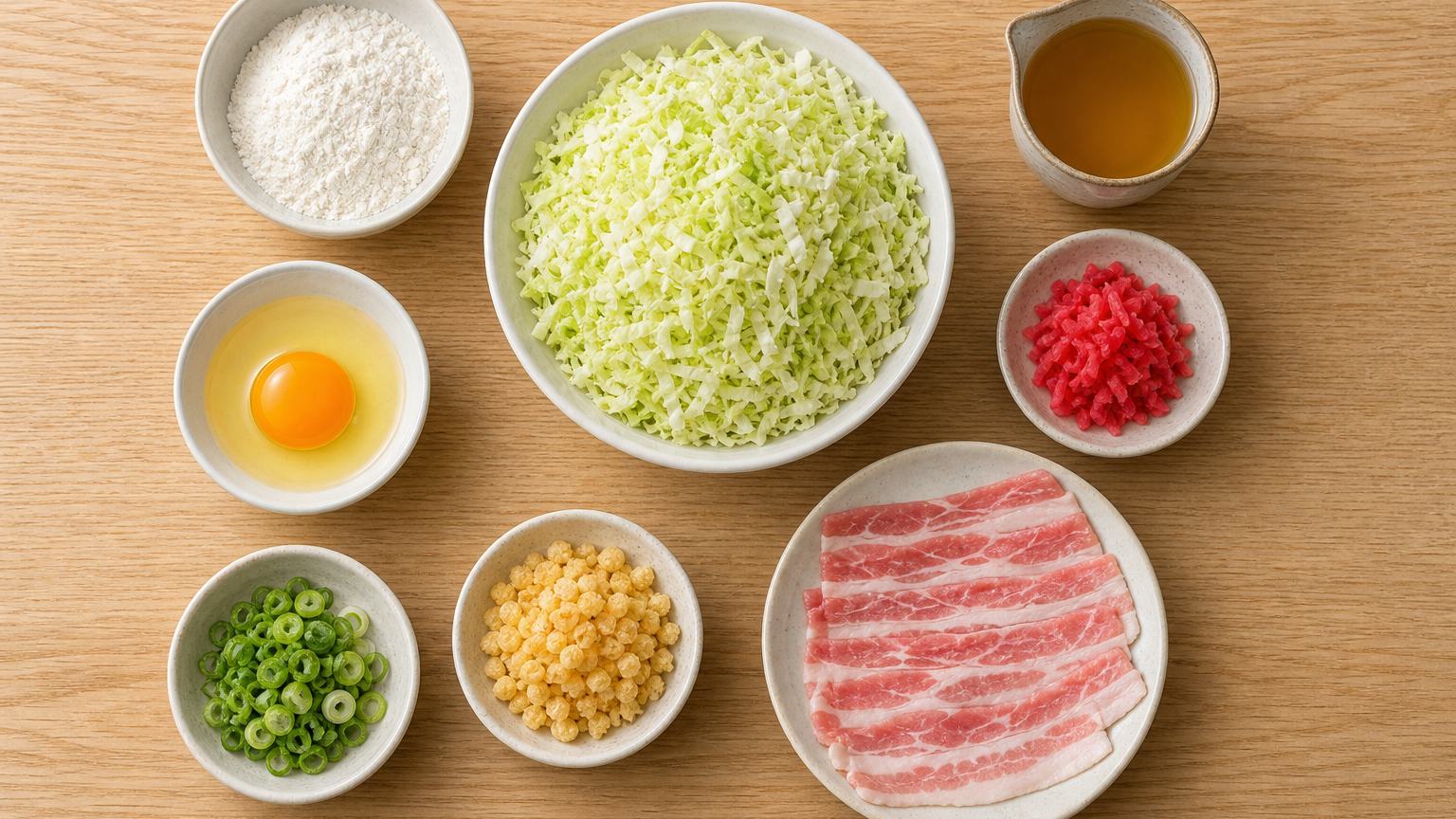
For the batter you need 100 g plain flour, 120 ml dashi stock, one large egg and 2 g fine salt. Into that go 250 g of finely shredded cabbage, two thinly sliced spring onions, 20 g tenkasu (the crisp tempura scraps) and 15 g of chopped pickled red ginger. You also want 100 g of very thinly sliced pork belly and 10 ml neutral oil. For the top: 40 g okonomiyaki sauce, 30 g Japanese mayonnaise, 5 g bonito flakes and 2 g aonori.
Cut the pork on its own board and wash your hands afterwards, before you touch anything else. Whisk the flour, dashi, egg and salt just until smooth, then stop. Fold in the cabbage, spring onions, tenkasu and ginger until everything is coated.
Heat half the oil in a wide nonstick pan over medium, spoon in half the mixture, and shape it into a round about 16 to 18 cm across and 2 to 3 cm thick without pressing it flat. Lay half the pork slices over the top. Cover and cook about 4 minutes, until the underside is deep golden and the edges have set firm enough to lift cleanly. Flip, cover again, and give it 4 to 5 minutes on the pork side, then one last 30 to 60 second flip to re-crisp. Repeat with the rest.
Sauce goes on while it's hot, then a drizzle of mayonnaise, then the bonito flakes and aonori. The flakes curl and move in the rising steam, which is worth watching once.
Gourmate's per-serving estimates put one of the two servings at about 626 calories, with 22 g protein, 42 g carbohydrate and 4 g fiber. It's a full dinner, not a starter.
Why the batter is mostly cabbage
Look at the ratio again: 250 g of cabbage against 100 g of flour. The vegetable is the body of the dish and the flour is only there to hold it together, which is the opposite of how most pancakes work.
That's also why the lid matters. The cabbage carries a lot of water, and covered on a medium heat it steams as much as it fries, which is what cooks a 3 cm pancake through before the outside burns. And because there's so little batter, how you mix it counts: beat flour and liquid hard and you develop gluten, which is what makes bread chewy and this tough. Stop as soon as the lumps go.
Kansai cooks often grate mountain yam into the batter for a lighter result, a variation Nippon.com notes alongside egg. This recipe leaves it out.
The flip, and getting the pork cooked
The flip is the part people dread. Two turners wider than a fish slice make it manageable: get one right under the pancake, steady the top with the second, and turn in one motion. If yours are narrow, slide the pancake onto a plate, invert the pan over it, and flip the pair together. Pancakes tear because they're too big for the pan, too wet, or lifted before the edges set, so fix those rather than getting braver.
Medium heat with a lid is deliberate: too hot and the pork chars before the middle sets, too cool and the pancake goes heavy. Timings that fixed depend on your burner, so treat 4 minutes as a starting point and judge the first pancake by cutting into its centre. Nothing should run. That batter contains raw egg, and springiness alone is not proof it's cooked. If you're pregnant, feeding young children, or cooking for someone elderly or immunocompromised, use pasteurised eggs.
Pork belly is a whole cut. The US Department of Agriculture puts the safe minimum at 145°F (63°C) with a three minute rest, a US figure, measured with a thermometer rather than judged by colour, since pork can stay pink past a safe temperature and can lose its pink before reaching one. Slices this thin are hard to probe alone, so probe the thickest part of the pancake through the pork layer and give the slices their full covered time face down.
And since raw pork touches both turners on the way over, wash them and your hands after the flip, not just the one that did the lifting. Keep the plate the slices sat on away from the finished pancake.
Allergens, and the ones the packet decides
This dish carries four of the regulated allergens outright. Wheat, from the flour and the tenkasu. Egg, from the batter and again from Japanese mayonnaise. Soy, from the sauce. Fish, from the bonito flakes and usually from the dashi as well, since standard dashi is kombu plus dried bonito. Crustaceans, fish, cereals containing gluten and soya all sit on the list of allergens that must be declared on packaged food in the UK and EU (Food Standards Agency).
Then there are the ones the packet decides. Bottled okonomiyaki sauce, instant dashi, tenkasu and Japanese mayonnaise are manufactured products whose recipes differ by brand, and anchovy, celery and mustard all turn up across that group. If you're cooking for a real allergy, read every label yourself rather than trusting a dish-level summary, this one included.
A vegetarian version is easy to get wrong. Dropping the pork isn't enough, because the dashi and the bonito flakes are both fish and the sauce may be too. Swap in a kombu and dried shiitake dashi, leave the flakes off, and check the sauce label. Kombu and shiitake together are a good example of how savouriness stacks, which our piece on what umami actually is gets into. Gluten is harder, since flour is doing structural work here, but a gluten-free flour blend plus omitting the tenkasu gets you a workable pancake with a softer edge.
Leftovers keep for a couple of days, though the crisp edge doesn't. Get them off the hot pan, spread them in a shallow container so they cool fast instead of sitting warm, refrigerate within two hours, eat within two to three days, and reheat until steaming hot right through.
What to serve with it
One okonomiyaki is rich: pork fat, mayonnaise and a sweet sauce all pulling the same direction. It wants something sharp next to it, which is exactly the job sunomono does.
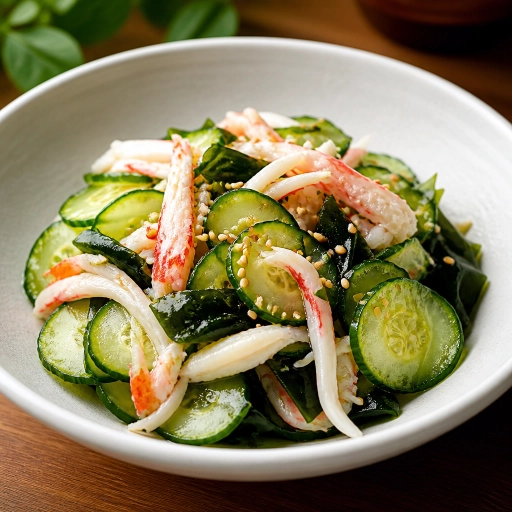
Sunomono
Sunomono is a crisp, refreshing cucumber and crab salad dressed in a lightly sweet rice-vinegar seasoning. The cucumber stays snappy, the crab adds delicate richness, and the sesame brings a warm nutty finish.
Thin cucumber rounds, salted with about a gram and left three minutes, squeezed dry, then dressed with rice vinegar, mirin and a little soy, with soaked wakame and cooked crab folded through and sesame on top. It takes 10 minutes, serves two, and lands around 78 calories a serving by Gourmate's per-serving estimates. Squeezing the cucumber is the step to not skip, or the dressing turns watery.
Two flags. The crab makes this a crustacean dish, which is a separate allergen from fish, and soy and sesame come along with the dressing; leave the crab out and you still have a cucumber sunomono that works. And nothing here is cooked, so use crab that's already cooked and ready to eat, keep it cold until it goes in the bowl, and check your mirin, since true hon-mirin contains alcohol and this dressing never sees heat.
A jar of quick pickles does the same job, cucumber in a light rice vinegar brine especially.
Want more dishes like this, sized for your table and your fridge? Gourmate generates cookable recipes across more than 30 cuisines. Download Gourmate.