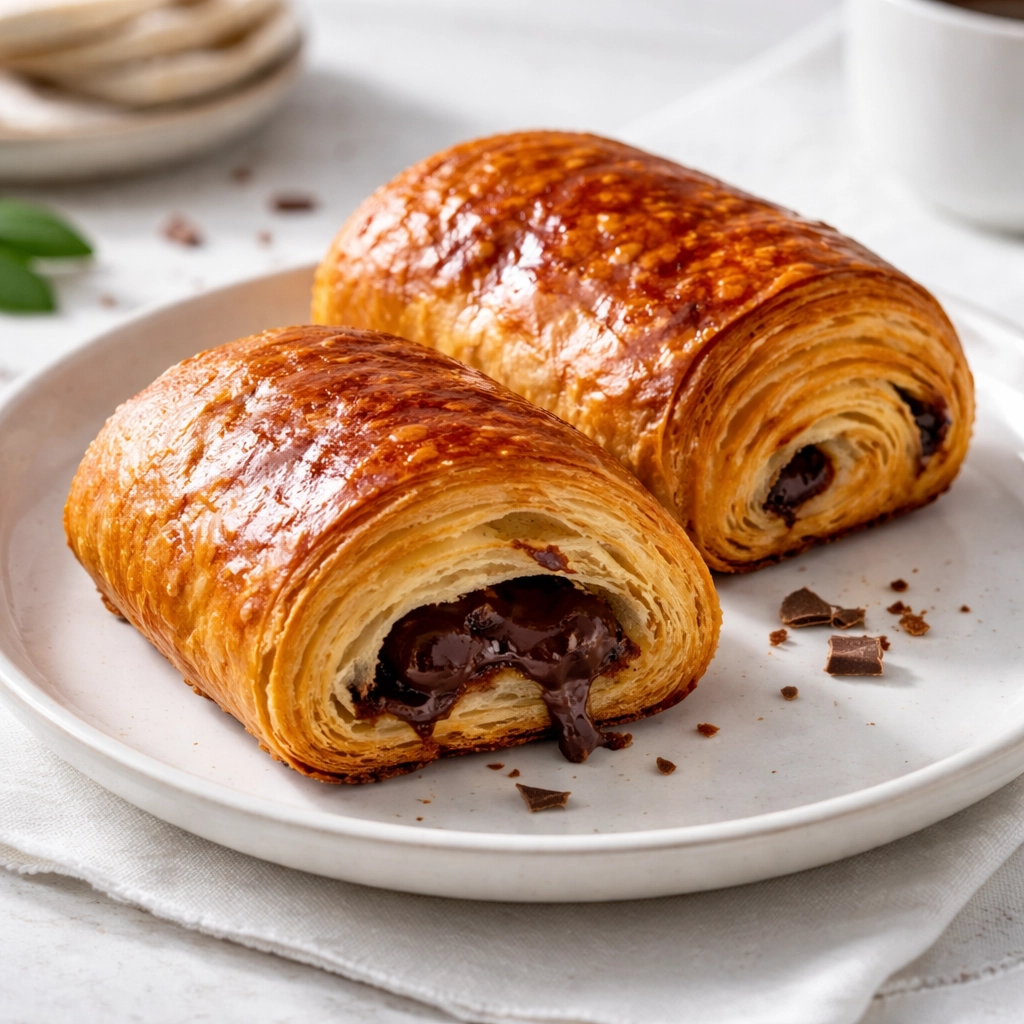
Pain au chocolat
Pain au chocolat is a flaky, buttery pastry wrapped around dark chocolate, with shattering outer layers and a tender honeycombed interior. This small-batch version delivers a classic bakery-style result with rich butter aroma and a molten chocolate center.
Nutrition · per serving
Ingredients
11 itemsDetrempe
Beurrage
Filling and finish
Tips
- •This is a deliberately accelerated, small-batch laminated dough designed to fit a 60-minute window; traditional pain au chocolat usually takes several hours with longer proofing and chilling.
- •For the cleanest layers, keep dough and butter at similar firmness throughout lamination: cold enough to hold shape, soft enough to roll without cracking.
- •If you cannot find chocolate batons, cut a good dark chocolate bar into narrow sticks about 5-6 cm long.
- •Bake until deeply golden rather than pale; underbaked laminated pastries can seem greasy and doughy inside.
- •Serve the same day for best texture.
Steps
- 1
Make the detrempe: in a bowl, combine the strong white bread flour, fine sea salt, and caster sugar. Add the instant yeast on the opposite side of the bowl from the salt, then add the cold whole milk, cold water, and softened unsalted butter. Mix until a shaggy dough forms, then knead for 4-5 minutes until smooth and only lightly elastic. Do not fully develop the gluten as if making sandwich bread; a moderately mixed dough laminates more easily.
140 g strong white bread flour3 g fine sea salt18 g caster sugar4 g instant yeast70 g whole milk, cold20 g cold water10 g unsalted butter, softened - 2
Shape the dough into a 12 x 8 cm rectangle, wrap or cover, and chill for 10 minutes. Meanwhile, place the cold unsalted butter between sheets of baking paper and pound-roll it into an even 10 x 7 cm slab about 5-6 mm thick. If the butter softens, chill briefly; it should be cold but pliable, matching the dough's firmness.
85 g unsalted butter, cold - 3
On a lightly floured surface, roll the chilled dough to about 20 x 12 cm. Place the butter slab over one half and fold the dough over to fully enclose it, sealing the edges. Roll gently lengthwise into a rectangle about 30 x 12 cm. Brush off excess flour and fold in thirds like a letter. This is the first turn.
- 4
Chill the dough for 10 minutes to relax the gluten and re-firm the butter. Rotate it 90 degrees, seam to your side, then roll again to about 30 x 12 cm and fold in thirds for the second turn. Work quickly; if butter starts smearing or leaking, stop and chill before continuing.
- 5
Chill for 10 minutes, then roll the dough into a neat rectangle about 24 x 16 cm and 4-5 mm thick. Trim the edges for clean layers if desired, then cut into 4 equal rectangles. Lay 1 piece of dark chocolate near one short edge of each rectangle, fold over once, add another piece if needed to use all the chocolate, and continue rolling tightly but without squashing the layers.
40 g dark chocolate batons or narrow bars - 6
Arrange the pastries seam-side down on a lined tray with space between them. Whisk the egg with the whole milk to make an egg wash, then brush the pastries lightly. Let them rest at warm room temperature for about 20 minutes, until slightly puffy; because this is a quick laminated dough, they will not double like brioche. Near the end of the rest, preheat the oven to 200 C.
1 medium egg10 g whole milk - 7
Brush once more very lightly with egg wash for a glossy finish, avoiding heavy drips on the cut edges which can inhibit lift. Bake at 200 C for 8 minutes, then reduce to 180 C and bake 6-8 minutes more until deeply golden with visible layered expansion. The bottoms should be well browned and the centers no longer look doughy.
1 medium egg10 g whole milk - 8
Cool on the tray for 5 minutes, then transfer to a rack for another 2-3 minutes before serving. They are best eaten warm, when the chocolate is molten and the outer layers are crisp.
Origin & History
Pain au chocolat is a classic viennoiserie from France, made from laminated yeast dough closely related to croissant dough. Though debates about naming exist in different regions of France, the pastry itself has long been a staple of French bakeries, especially for breakfast and afternoon snacks.
Do even more with Gourmate
Cook this recipe in Gourmate — your AI meal planning app.
Plan Meals
Weekly planner at a tap
Ask Questions
Chat with your AI chef
Adjust Recipe
Scale servings & swap ingredients
Cook Mode
Step-by-step guidance
Kitchen Timers
Built-in timers & alerts
Grocery List
Auto-generated shopping lists