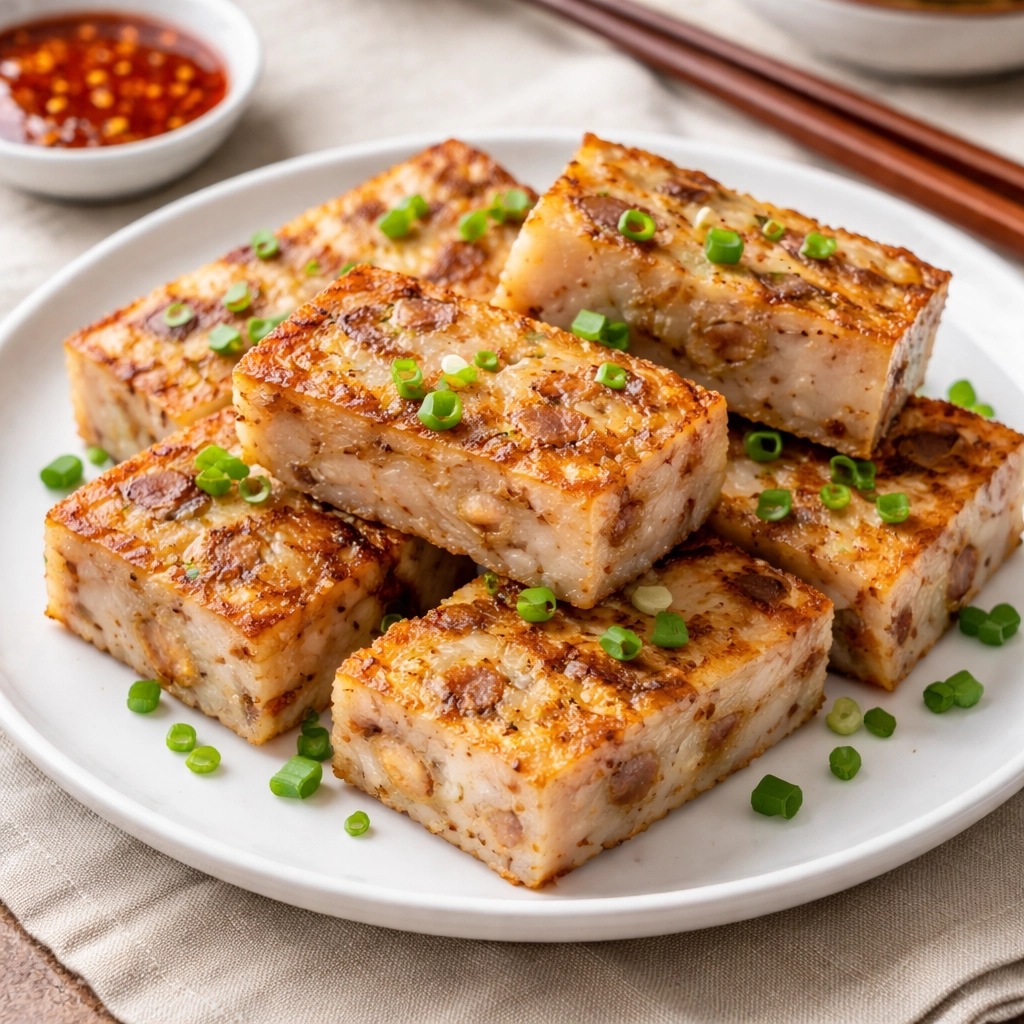
Lo Bak Gou
This taro cake is soft and savory inside, with fragrant bites of dried shrimp, Chinese sausage, and spring onion in every slice. After steaming, the pieces are pan-fried until golden, giving the outside a delicate crust that contrasts beautifully with the dense, silky center.
Nutrition · per serving
Ingredients
13 itemsTaro cake batter
Savory mix-ins
For steaming and pan-frying
Tips
- •If the batter seems too stiff before steaming, add 1-2 tablespoons of water; taro can vary in dryness.
- •For cleaner slices, cool the steamed cake completely before cutting, then pan-fry just before serving.
- •A small nonstick loaf tin speeds up steaming and helps the cake set within the 45-minute target.
- •Serve with chili sauce or a little extra soy sauce, though the cake should already be well seasoned.
Steps
- 1
Soak the dried shrimp in hot water for 10 minutes to soften, then drain well and roughly chop. While they soak, peel the taro and cut it into 1 cm dice, dice the Chinese sausage finely, and slice the spring onions. Lightly oil a small heatproof loaf tin or cake tin, about 18 x 10 cm.
20 g dried shrimp400 g taro, peeled and cut into 1 cm dice60 g Chinese sausage, finely diced25 g spring onions, thinly sliced15 ml neutral oil - 2
In a bowl, whisk the rice flour, water, fine salt, white pepper, and sugar into a smooth slurry with no lumps. Let it stand while you cook the fillings; this helps the flour hydrate evenly.
120 g rice flour260 ml water4 g fine salt1 g white pepper3 g sugar - 3
Heat a frying pan over medium heat with the neutral oil. Add the Chinese sausage and cook for 1-2 minutes until it starts to render and smell fragrant. Add the chopped dried shrimp and cook 30 seconds more. Stir in the spring onions, light soy sauce, and sesame oil.
10 ml neutral oil60 g Chinese sausage, finely diced20 g dried shrimp25 g spring onions, thinly sliced10 ml light soy sauce5 ml sesame oil - 4
Add the diced taro to the pan and toss for 2-3 minutes so the cubes are coated in the flavorful fat. The edges should look slightly translucent but the taro should still be firm; do not fully cook it at this stage.
400 g taro, peeled and cut into 1 cm dice - 5
Reduce the heat to low and stir the rice flour slurry again, then pour it into the pan. Cook, stirring and folding constantly, for 2-3 minutes until the mixture thickens into a heavy, spoonable mass that just holds together. Scrape it into the oiled tin and press it down firmly to remove air pockets; smooth the top with a wet spoon or spatula.
120 g rice flour260 ml water4 g fine salt1 g white pepper3 g sugar15 ml neutral oil - 6
Steam over rapidly simmering water for 20 minutes, covered, until the cake is firm and a skewer inserted in the center comes out mostly clean. Top up the steamer with hot water if needed so it does not boil dry.
- 7
Remove the tin from the steamer and rest the cake for 10 minutes so it firms up enough to slice cleanly. Run a knife around the edge, unmold, and cut into 6 pieces.
- 8
For the classic dim sum finish, heat a clean frying pan over medium heat with a little of the remaining oil and pan-fry the slices for 2-3 minutes per side until golden and lightly crisp on the surface, while the inside stays tender. Serve hot.
15 ml neutral oil
Origin & History
Lo bak gou is a classic Cantonese savory cake traditionally made with daikon radish, flour, and preserved ingredients, then served at dim sum or during Lunar New Year. Taro versions are a popular variation in southern Chinese cooking, prized for their earthy flavor and creamy texture. Pan-frying the steamed slices is the customary finishing touch for contrast and aroma.
Do even more with Gourmate
Cook this recipe in Gourmate — your AI meal planning app.
Plan Meals
Weekly planner at a tap
Ask Questions
Chat with your AI chef
Adjust Recipe
Scale servings & swap ingredients
Cook Mode
Step-by-step guidance
Kitchen Timers
Built-in timers & alerts
Grocery List
Auto-generated shopping lists