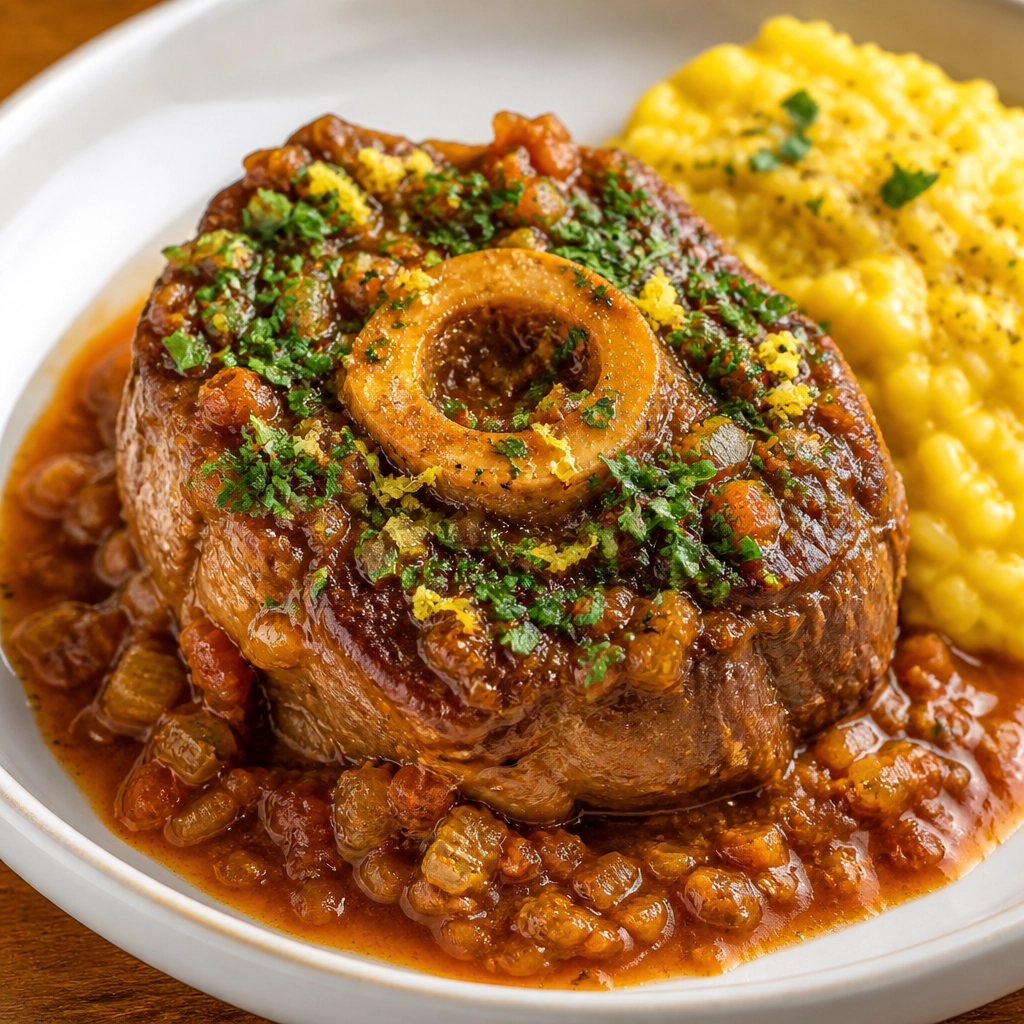
Ossobuco alla Milanese
Ossobuco alla Milanese is rich, tender veal shank braised until the meat yields easily while the marrow stays luscious in the bone. White wine, soffritto, tomato, and stock form a glossy sauce, finished with bright gremolata for the classic Milanese lift.
Nutrition · per serving
Ingredients
20 itemsVeal shanks and dredging
Braising base
Gremolata
Finishing
Tips
- •A classic braised ossobuco cannot realistically reach its proper tender, collagen-rich texture in 60 minutes; this recipe gives the true minimum for a traditional result.
- •Choose rear veal shanks if possible: they are meatier and hold together well during braising.
- •Keep the simmer gentle. A hard boil can toughen the meat and shake the marrow out of the bone.
- •For a cleaner presentation, pass the sauce through a coarse sieve; for a more rustic Milanese style, leave the softened soffritto in the sauce.
Steps
- 1
Heat the oven to 160°C. Pat the veal shanks very dry and make 2 or 3 tiny snips in the outer connective tissue of each piece so they do not curl. Tie each shank around its circumference with kitchen twine to help it keep its shape, then season all over with the fine sea salt and freshly ground black pepper.
4 pieces, about 1.2 kg total veal shanks, bone-in, 4 cm thick10 g fine sea salt2 g freshly ground black pepper - 2
Spread the plain flour on a tray and dredge the shanks lightly, shaking off every excess bit of flour; a thin coating browns better and prevents a pasty sauce. In a heavy Dutch oven just wide enough to hold the shanks in one layer, heat the unsalted butter and extra-virgin olive oil over medium-high heat until foaming. Brown the shanks deeply on both cut sides, about 4 minutes per side, handling them gently so the marrow stays in the bone. Transfer to a plate.
4 pieces, about 1.2 kg total veal shanks, bone-in, 4 cm thick40 g plain flour30 g unsalted butter30 ml extra-virgin olive oil - 3
Lower the heat to medium. Add the yellow onion, carrot, celery, and lightly crushed garlic clove to the same pot and cook for 8–10 minutes, scraping up the browned veal fond as the vegetables release moisture. The soffritto should soften and turn sweet but not scorch; reduce the heat if the bottom darkens too quickly.
150 g yellow onion, finely diced100 g carrot, finely diced80 g celery stalk, finely diced1 garlic clove, lightly crushed - 4
Pour in the dry white wine and boil for 4–5 minutes, scraping thoroughly, until reduced by about half and the raw alcohol smell has faded. Stir in the tomato passata, hot veal stock, bay leaf, and fresh thyme sprigs, then bring the liquid to a gentle simmer.
250 ml dry white wine150 g tomato passata400 ml veal stock, hot1 bay leaf2 fresh thyme sprigs - 5
Return the shanks to the pot in a single layer, cut side up if possible; the liquid should come about halfway to two-thirds up the meat, not cover it completely. Cover with a tight lid and braise in the oven for 90–105 minutes, turning the shanks once halfway through and basting with sauce. They are done when a skewer slides into the meat with little resistance and the meat is tender but still attached to the bone.
4 pieces, about 1.2 kg total veal shanks, bone-in, 4 cm thick250 ml dry white wine150 g tomato passata400 ml veal stock, hot1 bay leaf2 fresh thyme sprigs - 6
While the veal braises, make the gremolata. Mix the flat-leaf parsley leaves, unwaxed lemon zest, finely grated garlic clove, and fine sea salt for gremolata in a small bowl. Keep it raw and fresh; do not add it early, or the lemon and parsley aromas will dull.
20 g flat-leaf parsley leaves, finely chopped5 g unwaxed lemon zest, finely grated1 garlic clove, finely grated1 g fine sea salt for gremolata - 7
Transfer the cooked shanks carefully to a warm plate and rest for 10 minutes, loosely covered. Remove the bay leaf, thyme sprigs, and crushed garlic from the sauce. If the sauce is thin, simmer it uncovered on the stovetop for 5–8 minutes until lightly glossy; if too thick, loosen with a splash of hot water or stock. Whisk in the unsalted butter for finishing off the heat to round the sauce.
4 pieces, about 1.2 kg total veal shanks, bone-in, 4 cm thick20 g unsalted butter for finishing - 8
Return the shanks to the sauce just long enough to coat and warm them. Serve one shank per person with plenty of sauce and a generous pinch of gremolata scattered over the top at the last moment. Spoon out the marrow at the table and serve traditionally with risotto alla Milanese, polenta, or buttered mashed potatoes.
4 pieces, about 1.2 kg total veal shanks, bone-in, 4 cm thick20 g flat-leaf parsley leaves, finely chopped5 g unwaxed lemon zest, finely grated1 garlic clove, finely grated1 g fine sea salt for gremolata
Origin & History
Ossobuco is a landmark dish of Milan and Lombardy, traditionally made with cross-cut veal shanks whose central marrow bone gives the dish its name: “bone with a hole.” The older Milanese versions were often paler and less tomato-forward, while modern classic versions commonly include a modest amount of tomato and are finished with gremolata. It is famously served with risotto alla Milanese or soft polenta.
Do even more with Gourmate
Cook this recipe in Gourmate — your AI meal planning app.
Plan Meals
Weekly planner at a tap
Ask Questions
Chat with your AI chef
Adjust Recipe
Scale servings & swap ingredients
Cook Mode
Step-by-step guidance
Kitchen Timers
Built-in timers & alerts
Grocery List
Auto-generated shopping lists