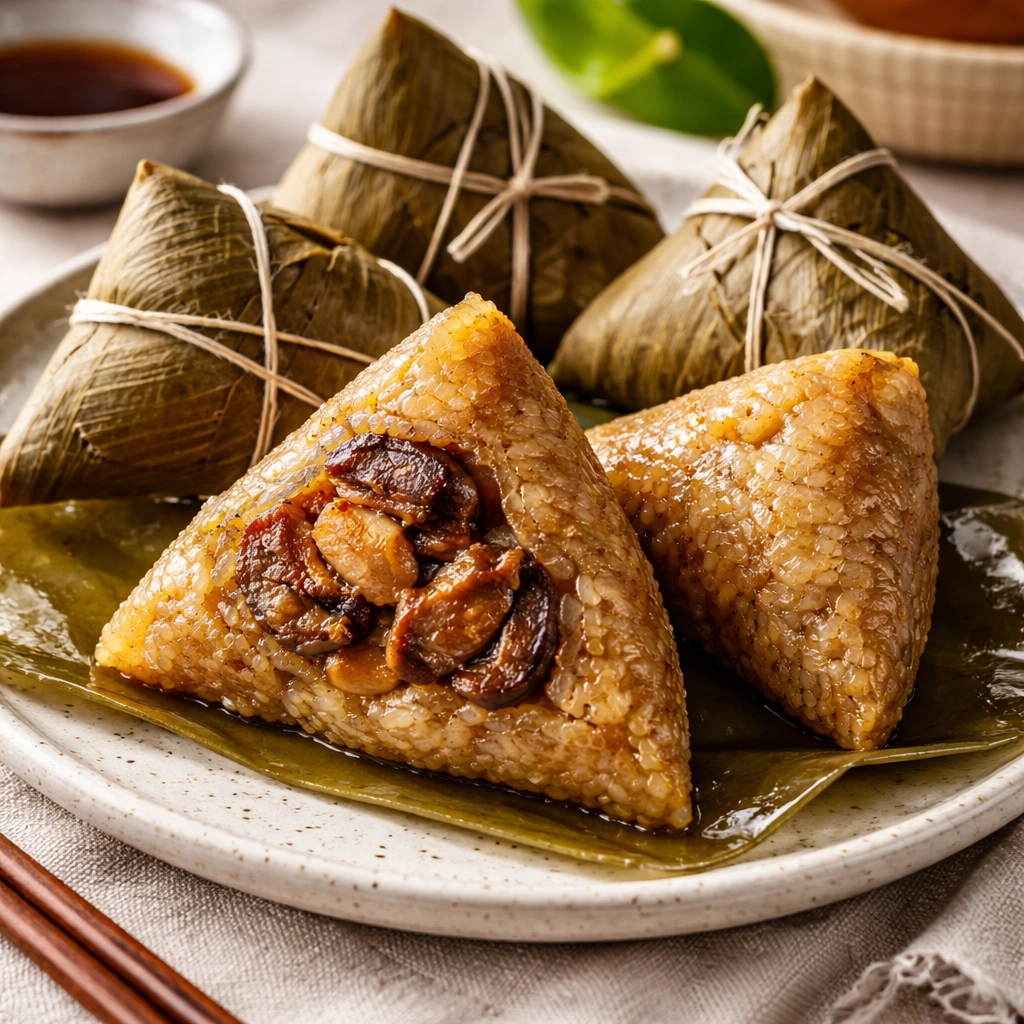
Zongzi
These savory zongzi are dense, fragrant, and richly satisfying, with glossy sticky rice wrapped around tender pork belly, earthy shiitake, and briny dried shrimp. The bamboo leaves perfume the dumplings as they cook, giving them the unmistakable aroma of a classic festival favorite.
Nutrition · per serving
Ingredients
16 itemsRice and wrappers
Pork and mushroom filling
Seasoning for the rice
Tips
- •If your bamboo leaves are small or split, use 3 leaves per dumpling for security.
- •A pressure cooker is the only practical way to achieve authentic texture within 60 minutes; conventional simmering usually takes 2 to 3 hours.
- •You can serve zongzi plain, or with a little extra light soy sauce on the side.
- •For neater parcels, keep a bowl of water nearby to wet your fingers when handling sticky rice.
Steps
- 1
Rinse the glutinous rice in several changes of cold water until the water is mostly clear, then soak it in plenty of water for 30 minutes. At the same time, soak the dried shiitake mushrooms and dried shrimp in hot water for 20 minutes, and soak the dried bamboo leaves in hot water for 20 minutes until pliable.
300 g glutinous rice20 g dried shiitake mushrooms20 g dried shrimp12 leaves dried bamboo leaves - 2
Drain the mushrooms and shrimp well. Squeeze the mushrooms dry and cut them in half if large. Cut the pork belly into 8 even chunks, about 2.5 cm each, so every dumpling gets substantial filling.
20 g dried shiitake mushrooms20 g dried shrimp180 g pork belly, skinless - 3
Marinate the pork belly with the light soy sauce, dark soy sauce, Shaoxing wine, five-spice powder, white pepper, sugar, and fine salt. Mix thoroughly and let it stand for 10 minutes while you prepare the rice; a short marinade is enough because the pieces are small and the seasoning is assertive.
180 g pork belly, skinless20 ml light soy sauce10 ml dark soy sauce15 ml Shaoxing wine2 g five-spice powder1 g white pepper4 g sugar3 g fine salt - 4
Drain the soaked rice very well, then mix it with the light soy sauce, neutral oil, and fine salt until evenly coated. Proper draining is important so the rice seasons instead of becoming watery.
300 g glutinous rice15 ml light soy sauce10 ml neutral oil2 g fine salt - 5
Wash each softened bamboo leaf under running water, especially along the veins, then trim off any hard stem ends. Pat them lightly dry. This prevents grit and helps the parcels fold cleanly without tearing.
12 leaves dried bamboo leaves - 6
Form the zongzi one at a time: overlap 2 bamboo leaves with the smooth sides facing inward and curve them into a cone. Add a thin layer of seasoned rice, then 1 pork piece, some mushroom, and a few dried shrimp. Cover with more rice and press gently so the filling is enclosed and the dumpling feels compact. Fold the top down, wrap the sides tightly into a triangular or pillow shape, and tie firmly with kitchen twine. Repeat to make 4 dumplings. Tight wrapping is essential; if the parcel feels loose, unwrap and redo it so the rice cooks evenly and does not leak.
12 leaves dried bamboo leaves300 g glutinous rice180 g pork belly, skinless20 g dried shiitake mushrooms20 g dried shrimp8 pieces kitchen twine - 7
Place the zongzi snugly in a pressure cooker and cover with fresh water by about 2 cm. Set a heatproof plate on top if needed to keep them submerged. Pressure-cook at high pressure for 35 minutes, then allow a natural release for 10 minutes. This shortened method makes the 60-minute target realistic; traditionally they are simmered much longer.
- 8
Lift the zongzi out carefully and rest them for 5 minutes so the rice firms slightly. Untie, unwrap, and serve hot. The rice should be glossy and sticky with no chalky core, and the pork should be fully tender.
Origin & History
Zongzi are traditional Chinese sticky rice dumplings wrapped in leaves, most famously associated with the Duanwu, or Dragon Boat Festival. Their origin is often linked in popular memory to offerings made in honor of the poet Qu Yuan, though leaf-wrapped rice dumplings also reflect older regional food traditions across China. Savory pork-filled versions are especially common in southern Chinese cuisines.
Do even more with Gourmate
Cook this recipe in Gourmate — your AI meal planning app.
Plan Meals
Weekly planner at a tap
Ask Questions
Chat with your AI chef
Adjust Recipe
Scale servings & swap ingredients
Cook Mode
Step-by-step guidance
Kitchen Timers
Built-in timers & alerts
Grocery List
Auto-generated shopping lists