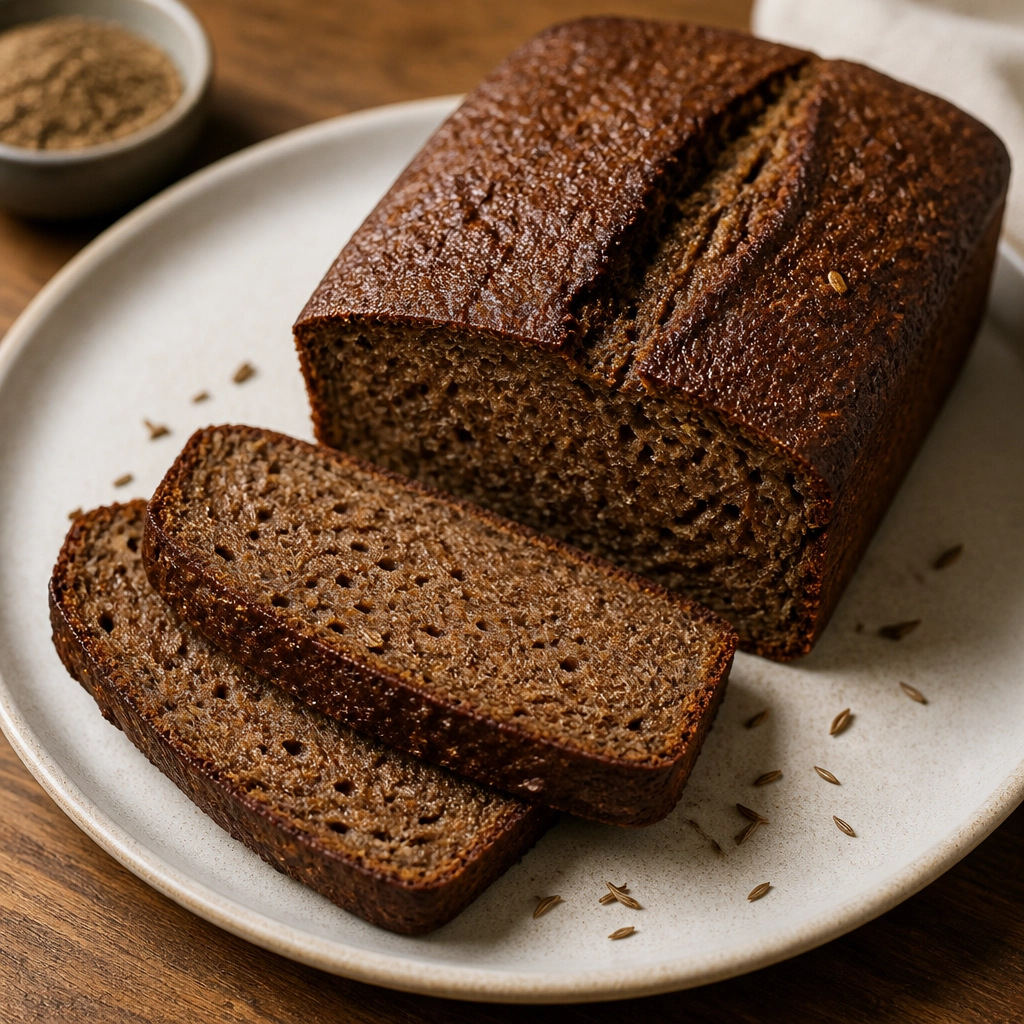
Roggenbrot
Roggenbrot is a dense, dark, aromatic rye loaf with a moist crumb and a gently tangy sourdough flavour. Caraway seeds add a warm, distinctive fragrance that pairs beautifully with the earthy depth of the rye.
Nutrition · per serving
Ingredients
7 itemsSourdough and dough
For the tin
Tips
- •This fast version assumes you already have a fully active rye sourdough starter; building the starter from scratch would take several days and is not included in the timing.
- •Using a loaf tin is traditional for many dense German rye breads and gives better structure than free-form shaping.
- •Wet tools and hands make rye dough much easier to handle because it is naturally sticky.
- •For a stronger caraway flavour, lightly crush the seeds before mixing them into the dough.
- •The loaf improves in texture after several hours of cooling; if you can, bake ahead and slice once fully cooled.
Steps
- 1
Preheat the oven to 240 C. Lightly oil a small loaf tin, about 20 x 10 cm, then dust it with rye flour so the sticky rye dough releases easily after baking.
5 g neutral oil10 g dark rye flour - 2
In a large bowl, stir the active rye sourdough starter with the warm water until loosened. Add the dark rye flour, fine sea salt, and caraway seeds. Mix thoroughly with a sturdy spoon or wet hand until no dry flour remains and you have a very thick, sticky paste-like dough. Rye dough should not feel elastic like wheat dough; smoothness is more important than kneading.
120 g active rye sourdough starter (100% hydration)300 g warm water380 g dark rye flour8 g fine sea salt8 g caraway seeds - 3
Scrape the dough into the prepared tin and smooth the top with a wet spatula or wet fingers. If desired, score a shallow line down the centre; with high-rye dough this is mostly decorative, but it can help guide the split.
- 4
Let the loaf rest and proof in the tin for about 10 minutes while the oven finishes heating. The surface may show tiny cracks and slight puffing; do not overproof or the loaf can collapse because rye has a fragile structure.
- 5
Bake for 15 minutes at 240 C to set the crust and encourage oven spring. Then reduce the oven to 200 C and bake for 25 minutes more, until the loaf is deeply browned and the centre reaches about 98 C if checked with a probe thermometer.
- 6
Turn the loaf out of the tin and return it directly to the oven rack for 5 more minutes to dry the sides and bottom. The bread should sound firm rather than hollow when tapped; rye breads stay dense by nature.
- 7
Cool on a rack for at least 5 minutes before slicing. For the cleanest crumb, wait longer if possible, as hot rye bread can seem gummy when cut too soon. Slice thickly and serve plain or with vegan butter, pickles, or soup.
Origin & History
Roggenbrot is a classic German rye bread, especially associated with regions where rye grows well in cooler climates. Traditional versions are often naturally leavened and can range from moderately light to very dense, with caraway commonly added for aroma and digestibility. Tin-baked sourdough rye loaves are a long-standing part of everyday bread culture across Germany.
Do even more with Gourmate
Cook this recipe in Gourmate — your AI meal planning app.
Plan Meals
Weekly planner at a tap
Ask Questions
Chat with your AI chef
Adjust Recipe
Scale servings & swap ingredients
Cook Mode
Step-by-step guidance
Kitchen Timers
Built-in timers & alerts
Grocery List
Auto-generated shopping lists