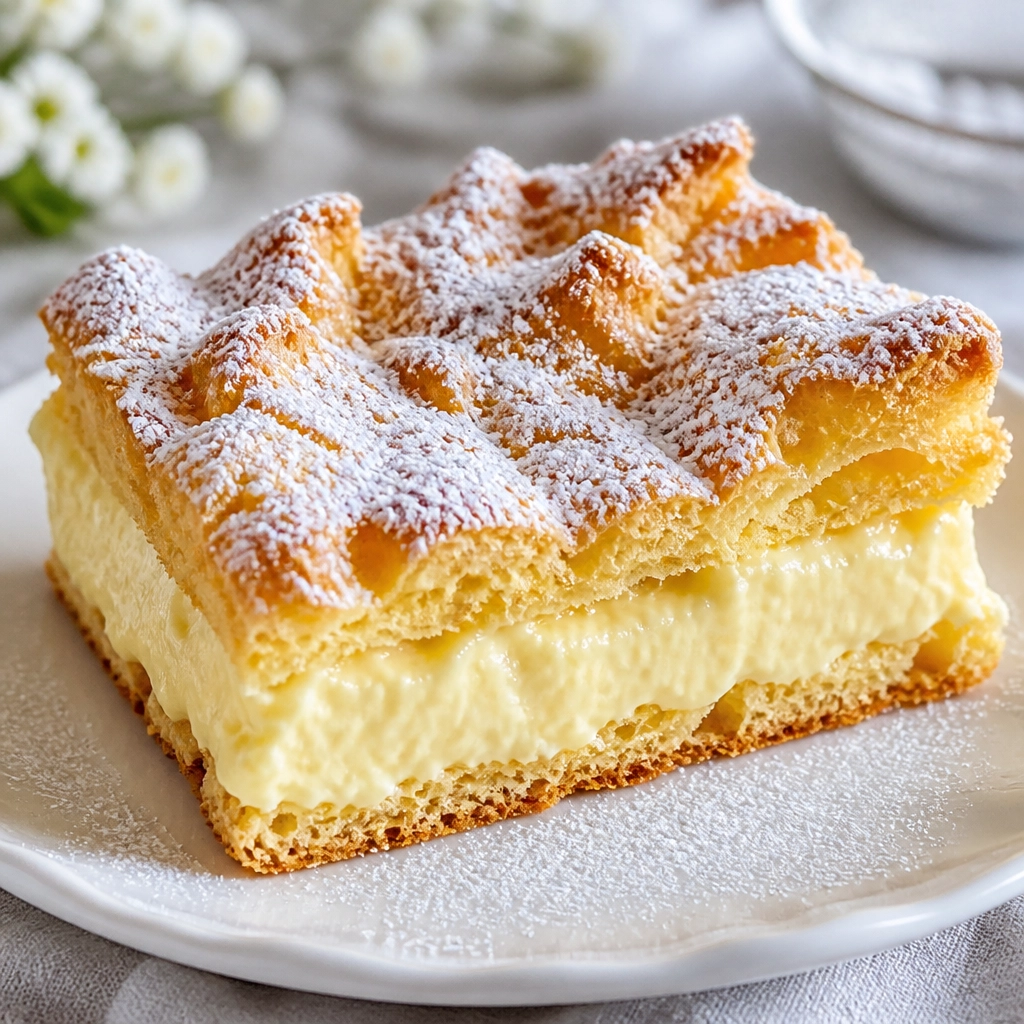
Karpatka
Karpatka is a dramatic Polish cream cake made with two rugged layers of baked choux pastry sandwiching a thick vanilla custard-butter cream. The contrast between the airy, lightly crisp pastry and the rich, silky filling makes each slice both delicate and indulgent.
Nutrition · per serving
Ingredients
12 itemsChoux layers
Vanilla custard cream
To finish
Tips
- •For the smoothest cream, the butter and cooled custard should be at similar room temperature before beating together.
- •Do not open the oven during the first 15 minutes of baking the choux layers, or they may deflate.
- •A metal tin gives slightly crisper choux, while a glass dish works well if fully preheated.
- •Karpatka is best the day it is made, once the cream has just set but the pastry still has some texture.
Steps
- 1
Preheat the oven to 210°C conventional heat. Line the base of a small baking tin or dish about 20 x 14 cm with baking paper. Take the butter for the cream out of the fridge so it softens fully; this helps the custard cream emulsify smoothly later.
80 g unsalted butter, softened - 2
Make the custard base first so it has time to cool. In a saucepan, heat most of the milk until steaming but not boiling. In a bowl, whisk the remaining milk with the egg yolks, caster sugar, cornstarch, and vanilla extract until completely smooth with no starch lumps.
300 ml whole milk2 egg yolks60 g caster sugar25 g cornstarch1 tsp vanilla extract - 3
Pour the hot milk gradually into the yolk mixture while whisking constantly, then return everything to the saucepan. Cook over medium heat, whisking all the time and reaching into the corners, until the custard becomes very thick and just starts to bubble. Cook 30 seconds more to remove any starchy taste. Transfer to a bowl, press baking paper or film directly onto the surface, and cool quickly until no longer warm.
300 ml whole milk2 egg yolks60 g caster sugar25 g cornstarch1 tsp vanilla extract - 4
For the choux, combine the water, butter, and salt in a saucepan and bring to a full boil so the butter is completely melted before the flour goes in.
125 ml water50 g unsalted butter1 pinch fine salt - 5
Add the flour all at once and stir vigorously with a wooden spoon or firm spatula until a smooth dough forms. Keep cooking for 1-2 minutes over medium heat, stirring constantly, until a thin film forms on the pan and the dough looks slightly dry; this cooks out excess moisture and gives better lift.
75 g plain flour - 6
Transfer the dough to a bowl and let it cool for 3-4 minutes, stirring once or twice so it stops steaming heavily. Beat in the eggs one at a time. At first the mixture will look split, then it will become glossy and smooth. The finished paste should be thick but spreadable and fall from the spatula in a heavy V-shape.
2 medium (about 100 g without shell) eggs - 7
Divide the choux paste into 2 equal portions. Spread one portion over the prepared tin in an even but rustic layer, leaving ridges and waves on top; these create the characteristic mountain-like surface. Bake for 20-22 minutes until deeply golden, puffed, and dry-looking. Remove and cool briefly, then repeat with the second portion. If using two tins, bake both at once and rotate halfway if needed.
- 8
When the custard base is fully cool, beat the softened butter until creamy. Add the cooled custard base one spoonful at a time, beating well after each addition, until the cream is silky and stable. If it looks slightly curdled, keep beating; it usually comes back together once fully incorporated.
80 g unsalted butter, softened - 9
Place one choux layer in the tin or on a tray. Spread the vanilla custard cream evenly over it, reaching the corners. Top with the second choux layer, craggy side up, and press very lightly so the filling settles without squashing out.
- 10
Rest the assembled Karpatka for 10 minutes to firm slightly, then dust generously with icing sugar. Slice with a serrated knife using a gentle sawing motion to avoid crushing the layers, and serve.
10 g icing sugar
Origin & History
Karpatka is a beloved Polish home-baked cake named after the Carpathian Mountains, whose snowy peaks are echoed by the craggy pastry dusted with icing sugar. It became especially popular in the 20th century as a celebratory yet accessible dessert, combining simple pantry ingredients with classic pastry technique.
Do even more with Gourmate
Cook this recipe in Gourmate — your AI meal planning app.
Plan Meals
Weekly planner at a tap
Ask Questions
Chat with your AI chef
Adjust Recipe
Scale servings & swap ingredients
Cook Mode
Step-by-step guidance
Kitchen Timers
Built-in timers & alerts
Grocery List
Auto-generated shopping lists