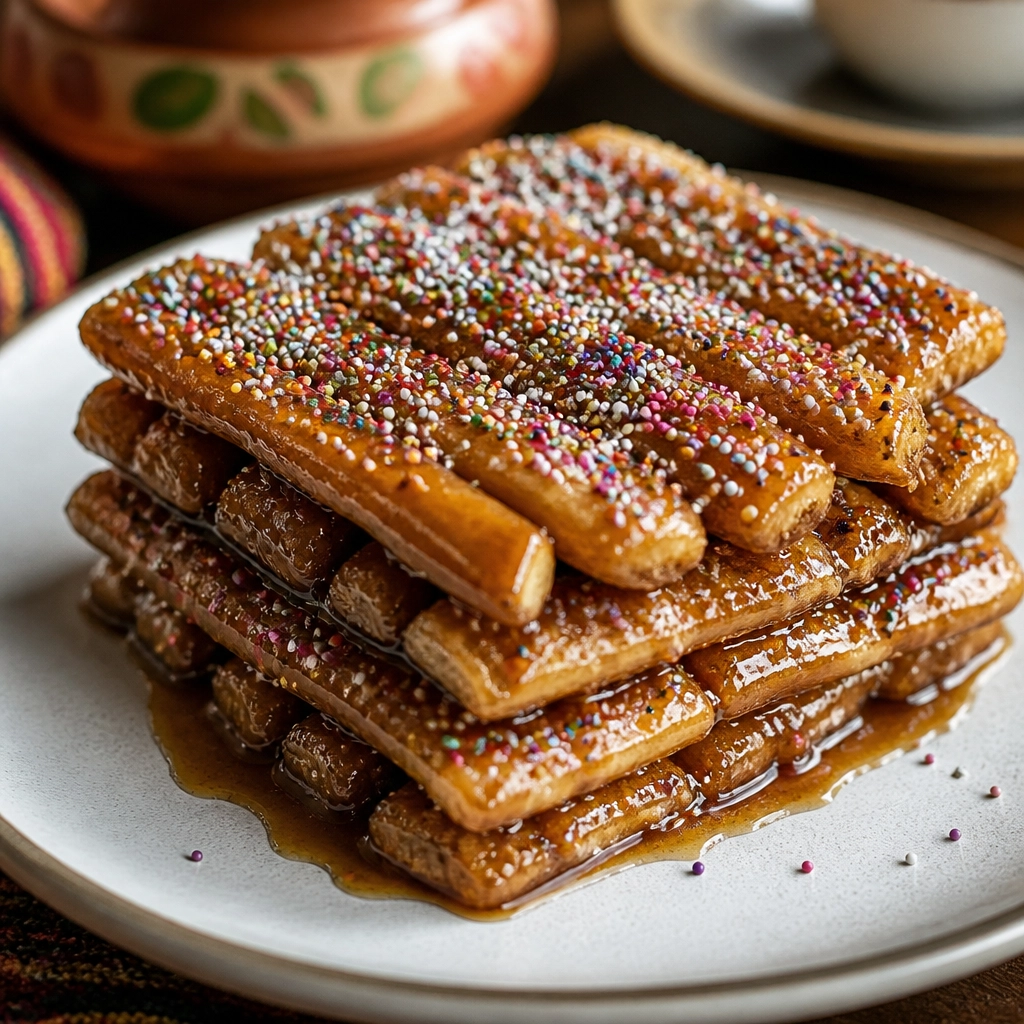
Turrón de Doña Pepa
This small-batch Turrón de Doña Pepa has crisp, anise-scented biscuit sticks layered with warm spiced honey syrup and finished with colorful nonpareils. The result is fragrant, sticky, buttery, and richly sweet, with the distinctive festive character of the classic Peruvian confection.
Nutrition · per serving
Ingredients
14 itemsFor the anise dough sticks
For the chancaca syrup
For finishing
Tips
- •Traditional Turrón de Doña Pepa is often made in a much larger slab with chancaca (unrefined cane syrup) and decorated generously; this scaled version keeps the classic flavor profile for 2 servings.
- •If you can find panela or chancaca, replace the dark brown sugar gram for gram for a deeper, more authentic molasses note.
- •Work quickly during assembly: cool syrup thickens fast, and hot baked sticks are more fragile than cooled ones.
- •This dessert is very sweet by design; it pairs well with unsweetened coffee, black tea, or anise tea.
Steps
- 1
Preheat the oven to 180°C conventional / 170°C fan. Line a baking tray or small rectangular pan with baking paper. In a small dry pan over low heat, toast the anise seeds for 30 to 45 seconds until fragrant, then lightly crush them with the back of a spoon or in a mortar. Toasting wakes up the oils and gives the dough its characteristic aroma without making it bitter.
4 g anise seeds - 2
In a bowl, whisk together the plain flour, fine sea salt, and crushed anise seeds. Rub in the unsalted butter and lard with your fingertips until the mixture looks like fine crumbs. Add the egg yolk and water, then mix just until a firm but pliable dough forms. Do not overwork it; too much mixing will toughen the baked sticks.
180 g plain flour1 g fine sea salt4 g anise seeds20 g unsalted butter35 g lard1 yolk (18 g) egg yolk35 ml water - 3
Transfer the dough to the lined tray and shape it into very thin logs, about 8 to 10 cm long and 1 cm thick, arranging them close together in parallel rows so they can later be layered. If the dough softens, chill it briefly for a few minutes; neat, even sticks bake more evenly and stack more cleanly.
180 g plain flour1 g fine sea salt4 g anise seeds20 g unsalted butter35 g lard1 yolk (18 g) egg yolk35 ml water - 4
Bake for 18 to 22 minutes, until the sticks are dry, lightly golden, and firm to the touch. They should feel crisp rather than soft in the center. Let them cool on the tray for 5 minutes so they set before handling.
- 5
While the dough bakes, make the syrup. In a small saucepan, combine the dark brown sugar, runny honey, water, orange peel, cinnamon stick, and whole cloves. Bring to a boil over medium heat, then reduce to a steady simmer for 10 to 12 minutes until slightly thickened and glossy. It should coat the back of a spoon lightly; if too thin, the turrón will collapse, and if too thick, it will not soak the layers properly.
90 g dark brown sugar70 g runny honey120 ml water2 wide strips (about 4 g) orange peel1 small stick (3 g) cinnamon stick2 whole cloves - 6
Strain out the orange peel, cinnamon stick, and cloves. Leave the syrup warm; warm syrup is easier to pour and helps the baked sticks adhere without turning soggy.
2 wide strips (about 4 g) orange peel1 small stick (3 g) cinnamon stick2 whole cloves - 7
Assemble the turrón on a small serving plate or in a small parchment-lined container. Lay down a first layer of baked dough sticks, spoon over some warm syrup, then add a second layer crosswise and spoon over more syrup. Finish with a third layer if you have enough sticks, pressing very gently so the layers settle but do not break. Use enough syrup to bind the layers generously while keeping some texture in the baked sticks.
90 g dark brown sugar70 g runny honey120 ml water180 g plain flour1 g fine sea salt4 g anise seeds20 g unsalted butter35 g lard1 yolk (18 g) egg yolk35 ml water - 8
Scatter the rainbow nonpareils over the top while the syrup is still tacky so they adhere well. Let the turrón rest for 8 minutes before slicing or portioning; this short rest helps the syrup settle and makes serving cleaner.
20 g rainbow nonpareils - 9
Serve in 2 portions. The finished turrón should be aromatic with anise and spice, lightly sticky, and tender-crisp in layered bites.
Origin & History
Turrón de Doña Pepa is one of Peru’s most iconic sweets, especially associated with the October celebrations of Señor de los Milagros in Lima. According to tradition, it is linked to a woman known as Doña Pepa, who created or popularized the dessert after a miraculous recovery. Its layered anise biscuits, sticky syrup, and bright sprinkles have become a hallmark of Peruvian festive baking.
Do even more with Gourmate
Cook this recipe in Gourmate — your AI meal planning app.
Plan Meals
Weekly planner at a tap
Ask Questions
Chat with your AI chef
Adjust Recipe
Scale servings & swap ingredients
Cook Mode
Step-by-step guidance
Kitchen Timers
Built-in timers & alerts
Grocery List
Auto-generated shopping lists