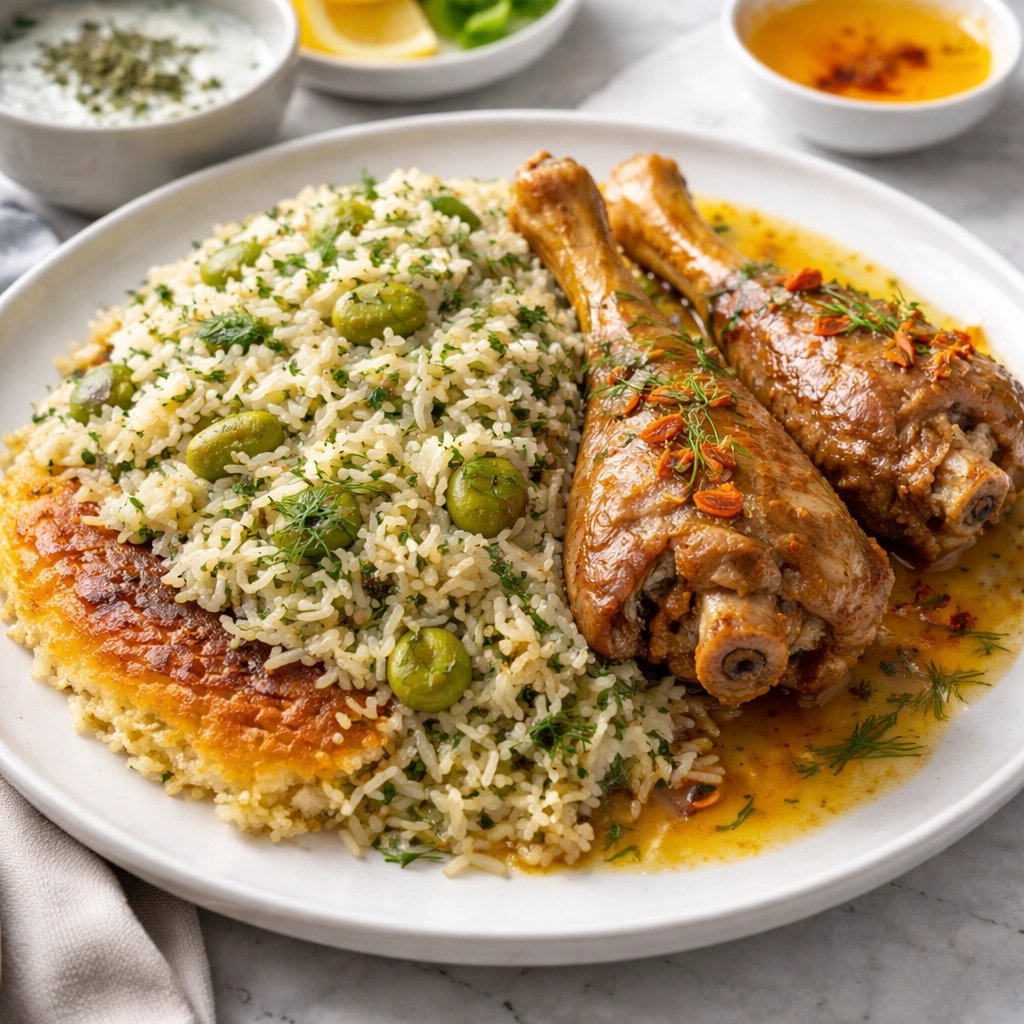
Baghali Polo ba Mahicheh
This dish combines fragrant basmati rice with sweet fava beans, fresh dill, and saffron for a vivid, herbaceous pilaf crowned with crisp golden tahdig. Tender lamb shanks braised with onion and turmeric make it rich, aromatic, and deeply comforting.
Nutrition · per serving
Ingredients
18 itemsFor the lamb
For the saffron
For the rice
Tips
- •Using small lamb shanks keeps the dish within the 60-minute target; larger shanks usually need 1 1/2 to 2 hours to become tender.
- •If using fresh fava beans with tough outer skins, peel them after blanching for a more refined texture.
- •For a stronger saffron aroma, bloom the saffron by crushing it very finely before adding the hot water.
- •A heavy-bottomed nonstick or well-seasoned pot makes it much easier to produce an even tahdig without burning.
Steps
- 1
Rinse the basmati rice in several changes of cold water until the water runs mostly clear. Cover with fresh cold water, add 1 tbsp fine salt, and soak for 20 minutes while you start the lamb.
200 g basmati rice1 tbsp, plus more for boiling water fine salt - 2
Grind the saffron threads with a pinch of salt if you like, then steep them in 2 tbsp hot water for at least 10 minutes until deeply colored.
1/4 tsp saffron threads2 tbsp hot water - 3
Heat 1 tbsp neutral oil in a medium heavy pot over medium-high heat. Pat the lamb shanks dry, then sear them for 3-4 minutes per side until lightly browned. Browning builds flavor, so do not crowd the pot.
2 small (about 700 g total) lamb shanks1 tbsp neutral oil - 4
Add the sliced onion and cook for 4 minutes until softened and lightly golden. Stir in the crushed garlic, turmeric, black pepper, and 1 1/4 tsp fine salt for 30 seconds until fragrant.
120 g onion, thinly sliced2 garlic cloves, crushed1 tsp ground turmeric1/2 tsp ground black pepper1 1/4 tsp fine salt - 5
Pour in 500 ml water, bring to a boil, then reduce to a steady simmer. Cover and cook for about 30 minutes, turning the shanks once, until the meat is tender enough to pierce easily with a knife and the liquid has reduced to a light braising sauce.
500 ml water2 small (about 700 g total) lamb shanks - 6
Meanwhile, bring 1.5 L water to a rolling boil in a large pot and salt it generously. Add the fava beans and boil for 2 minutes if fresh or 1 minute if thawed frozen, then add the soaked, drained rice. Boil for 5-6 minutes until the outside of each grain is soft but the center still has a slight bite. Drain well.
1.5 L for boiling, plus more as needed water120 g shelled fava beans, fresh or thawed frozen200 g basmati rice1 tbsp, plus more for boiling water fine salt - 7
Gently fold the drained rice with the chopped dill so the herbs are evenly distributed without breaking the grains.
35 g fresh dill, finely chopped200 g basmati rice - 8
In a clean pot, mix the yogurt with 15 g of the melted butter and half of the saffron water. Spread this mixture over the base of the pot, then spoon in the dill-fava rice in a loose mound. Drizzle over the remaining butter, 1 tbsp neutral oil, and the rest of the saffron water. Use the handle of a spoon to poke a few steam holes.
60 g plain yogurt40 g unsalted butter, melted1/4 tsp saffron threads2 tbsp hot water35 g fresh dill, finely chopped120 g shelled fava beans, fresh or thawed frozen200 g basmati rice1 tbsp neutral oil - 9
Wrap the lid in a clean kitchen towel or paper towel, cover the pot, and cook over medium heat for 5 minutes to start the tahdig. Then reduce to low and steam for 15 minutes, until the rice is fluffy and fully tender and the bottom crust is golden. You should smell a toasty, buttery aroma but not scorching.
- 10
Let the rice rest off the heat for 5 minutes. Resting helps the grains firm up and makes unmolding easier.
- 11
Taste the lamb sauce and adjust seasoning if needed. If the sauce is too thin, simmer uncovered for 1-2 minutes; it should lightly coat a spoon.
2 small (about 700 g total) lamb shanks - 12
Serve the lamb shanks alongside the rice, spooning a little sauce over the meat. Fluff the top rice gently and, if possible, lift out pieces of the tahdig from the bottom to serve separately.
2 small (about 700 g total) lamb shanks200 g basmati rice120 g shelled fava beans, fresh or thawed frozen35 g fresh dill, finely chopped
Origin & History
Baghali Polo is a beloved Persian rice dish traditionally made with dill and broad beans, often served at spring gatherings and festive meals. When paired with mahicheh, or lamb shank, it becomes a classic celebratory centerpiece associated with home cooking and special occasions in Iran.
Do even more with Gourmate
Cook this recipe in Gourmate — your AI meal planning app.
Plan Meals
Weekly planner at a tap
Ask Questions
Chat with your AI chef
Adjust Recipe
Scale servings & swap ingredients
Cook Mode
Step-by-step guidance
Kitchen Timers
Built-in timers & alerts
Grocery List
Auto-generated shopping lists