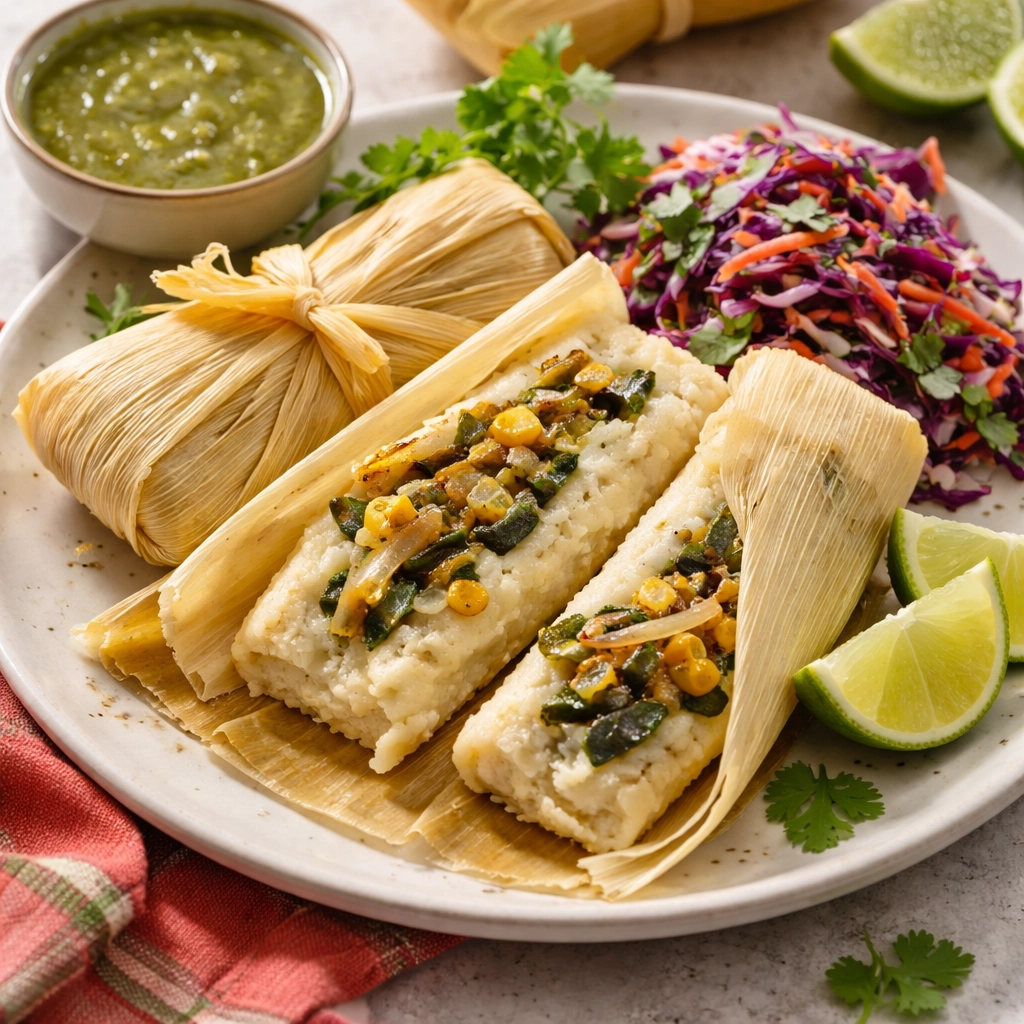
Tamales de Rajas
These tamales de rajas are soft, aromatic parcels of tender masa wrapped around smoky roasted poblano strips, sweet corn, and onion scented with epazote. The coconut oil keeps the masa rich and delicate while letting the roasted chile filling remain the star.
Nutrition · per serving
Ingredients
14 itemsPara las hojas y el vapor
Para el relleno de rajas
Para la masa
Tips
- •If epazote is unavailable, use a small amount of cilantro for freshness, though the flavor will be less traditional.
- •For lighter masa, beat it well after adding the stock; aeration helps compensate for the lack of lard.
- •A narrow, fairly dry filling is key: excess moisture can cause the tamales to open or cook up dense.
- •These tamales pair well with salsa verde, refried black beans, or a simple cabbage slaw.
Steps
- 1
Set the dried corn husks in a bowl and cover with hot water. Weigh them down with a plate so they stay submerged and soften while you prepare the filling and masa, about 20 minutes. Set up a steamer with water in the base so it is ready to heat later.
8 large dried corn husks1.5 litres water - 2
Roast the poblano peppers directly over a gas flame or under a very hot grill, turning until the skins are blistered and blackened on all sides, 8-10 minutes. Transfer to a bowl and cover for 10 minutes; this steaming step loosens the skin and keeps the flesh tender.
2 medium (about 240 g total) poblano peppers - 3
Peel the roasted poblanos, remove stems and seeds, then slice into thin strips. A few flecks of char are fine and add flavor, but remove any large burnt patches for a cleaner filling.
2 medium (about 240 g total) poblano peppers - 4
Heat the coconut oil in a frying pan over medium heat. Add the white onion and cook for 3-4 minutes until softened but not browned. Stir in the garlic and cook 30 seconds, then add the corn kernels, poblano strips, epazote, and fine sea salt. Cook for 2-3 minutes until the corn is hot and the mixture is fairly dry; wet filling makes tamales heavy. Remove from the heat.
12 g coconut oil100 g white onion, thinly sliced2 cloves (8 g) garlic, finely chopped120 g corn kernels5 g epazote, chopped3 g fine sea salt2 medium (about 240 g total) poblano peppers - 5
In a mixing bowl, beat the coconut oil with the fine sea salt for about 1 minute until creamy and slightly lighter. Mix in the masa harina and baking powder, then gradually pour in the warm vegetable stock while stirring until a soft, spreadable dough forms. Beat for 2-3 minutes more; the masa should resemble thick cake batter and spread easily on a husk without running.
45 g coconut oil4 g fine sea salt160 g masa harina4 g baking powder220 ml warm vegetable stock - 6
Drain the softened corn husks and pat dry. Select the 6 best husks for tamales and tear 2 husks into thin strips for ties if needed.
8 large dried corn husks - 7
Spread about 45-50 g of masa onto the smooth side of each husk, forming a rectangle roughly 10 x 12 cm in the upper two-thirds. Leave a border around the edges so the tamales can fold closed. Spoon the filling in a narrow line down the center of each.
8 large dried corn husks160 g masa harina220 ml warm vegetable stock45 g coconut oil4 g baking powder4 g fine sea salt12 g coconut oil100 g white onion, thinly sliced2 cloves (8 g) garlic, finely chopped120 g corn kernels5 g epazote, chopped3 g fine sea salt2 medium (about 240 g total) poblano peppers - 8
Fold the long sides of each husk toward the center so the masa encloses the filling, then fold up the narrow bottom end. Tie gently with husk strips only if the tamales do not hold closed on their own. Keep the top open so steam can circulate.
8 large dried corn husks - 9
Bring the steamer to a steady simmer. Arrange the tamales upright with the open ends facing up, packing them snugly so they stay upright. Cover with a clean cloth or extra husk pieces, then cover the pot and steam for 25 minutes. Check once midway and add more hot water if needed so the pot does not boil dry.
1.5 litres water8 large dried corn husks - 10
Turn off the heat and let the tamales rest in the covered steamer for 5 minutes. They are done when the masa feels set and the husk pulls away cleanly. If the masa still sticks heavily, steam 5 minutes more.
- 11
Serve hot, either directly in the husks or unwrapped on plates. The filling should be fragrant with roasted chile and epazote, and the masa should be tender and moist, not gummy.
Origin & History
Tamales are one of Mexico's oldest prepared foods, with roots stretching back to pre-Hispanic Mesoamerica, where masa was filled, wrapped, and steamed for travel and ritual occasions. Tamales de rajas, featuring strips of chile, became especially popular in central Mexico, and vegan versions are a natural adaptation of the many regional meatless tamales eaten during Lent and everyday home cooking.
Do even more with Gourmate
Cook this recipe in Gourmate — your AI meal planning app.
Plan Meals
Weekly planner at a tap
Ask Questions
Chat with your AI chef
Adjust Recipe
Scale servings & swap ingredients
Cook Mode
Step-by-step guidance
Kitchen Timers
Built-in timers & alerts
Grocery List
Auto-generated shopping lists