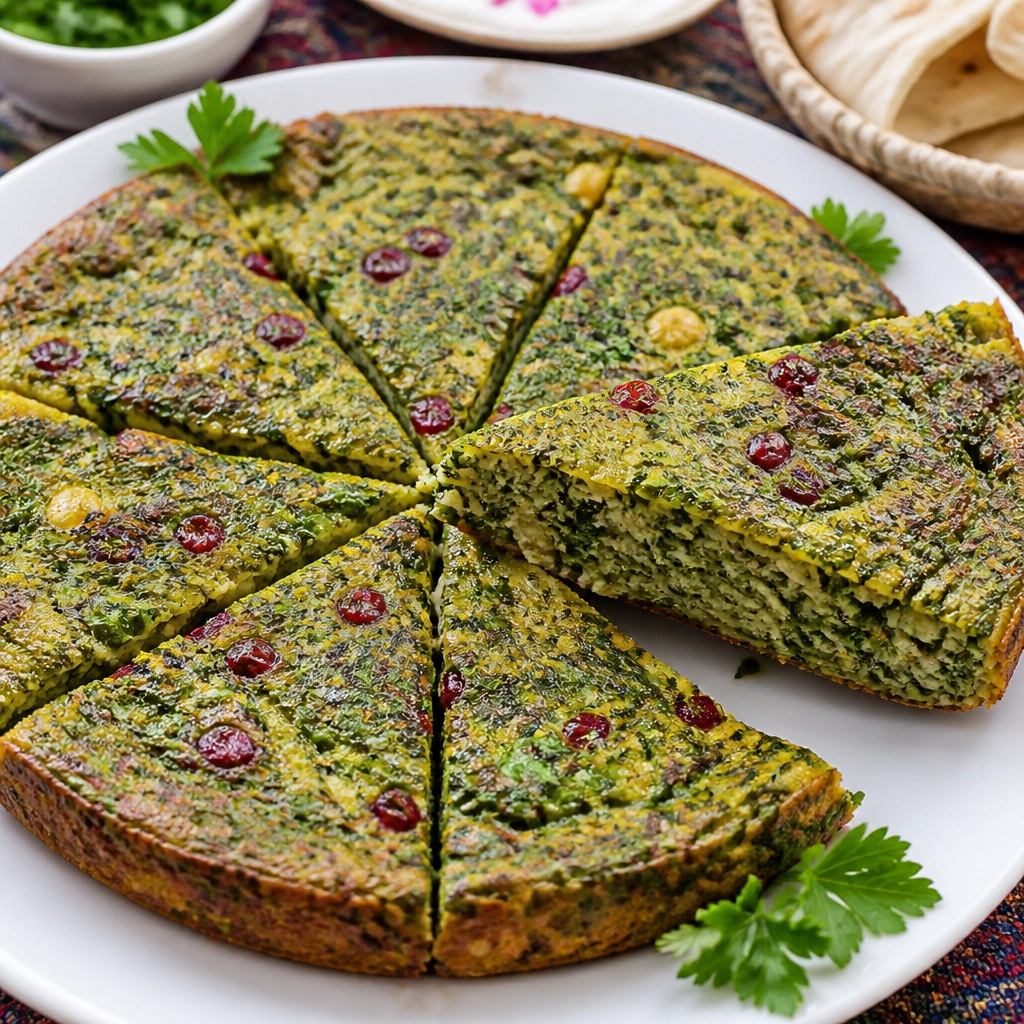
Kuku Sabzi
Kuku sabzi is a fragrant, emerald-green herb frittata packed with parsley, cilantro, scallions, and fenugreek. Studded with tart barberries and crunchy walnuts, it is light yet richly flavored, with a tender interior and gently golden crust.
Nutrition · per serving
Ingredients
12 itemsHerb and egg mixture
For the pan
Tips
- •If fresh fenugreek is available, use about 15 g finely chopped in place of the dried fenugreek leaves.
- •A small 20 cm nonstick pan gives the best thickness for 2 servings.
- •Kuku sabzi is delicious with lavash, yogurt, torshi, or a simple salad.
- •Do not overcrowd the pan with too much mixture depth; if using a smaller pan, cook even more gently over low heat.
Steps
- 1
Preheat a small nonstick frying pan with a lid over low heat. Finely chop the parsley and cilantro, slice the scallions, chop the walnuts, and quickly rinse the barberries; pat them dry so they do not water down the mixture.
60 g flat-leaf parsley, finely chopped40 g cilantro, finely chopped50 g scallions, finely sliced25 g walnuts, chopped15 g barberries - 2
Crack the eggs into a bowl and whisk until completely smooth and slightly frothy. Whisking well helps the kuku puff a little and keeps the texture tender.
4 large eggs - 3
Add the parsley, cilantro, scallions, dried fenugreek leaves, walnuts, barberries, turmeric, salt, black pepper, and baking powder to the eggs. Stir until evenly combined; the mixture should look very herb-heavy, which is traditional for kuku sabzi.
60 g flat-leaf parsley, finely chopped40 g cilantro, finely chopped50 g scallions, finely sliced5 g dried fenugreek leaves25 g walnuts, chopped15 g barberries1/2 tsp ground turmeric3/4 tsp fine salt1/4 tsp black pepper1/4 tsp baking powder4 large eggs - 4
Add the oil to the pan and swirl to coat the base and sides. Pour in the herb mixture, level the top, cover, and cook on low heat for 8-10 minutes until the edges are set and the underside is golden. Low heat is important so the center cooks through before the bottom browns too much.
20 ml neutral oil4 large eggs60 g flat-leaf parsley, finely chopped40 g cilantro, finely chopped50 g scallions, finely sliced5 g dried fenugreek leaves25 g walnuts, chopped15 g barberries1/2 tsp ground turmeric3/4 tsp fine salt1/4 tsp black pepper1/4 tsp baking powder - 5
Carefully flip the kuku using a plate, or slide it under a grill-safe lidless setup if that is easier. Cook the second side for 4-5 minutes until fully set in the center. A knife inserted in the middle should come out without raw egg.
- 6
Rest for 3 minutes, then cut into wedges and serve warm or at room temperature.
Origin & History
Kuku sabzi is a classic Persian herb frittata, especially associated with Nowruz, the Persian New Year, where its vivid green color symbolizes rebirth and spring. Unlike many omelets, it is defined more by herbs than eggs, reflecting the central role of fresh herbs in Iranian cooking.
Do even more with Gourmate
Cook this recipe in Gourmate — your AI meal planning app.
Plan Meals
Weekly planner at a tap
Ask Questions
Chat with your AI chef
Adjust Recipe
Scale servings & swap ingredients
Cook Mode
Step-by-step guidance
Kitchen Timers
Built-in timers & alerts
Grocery List
Auto-generated shopping lists