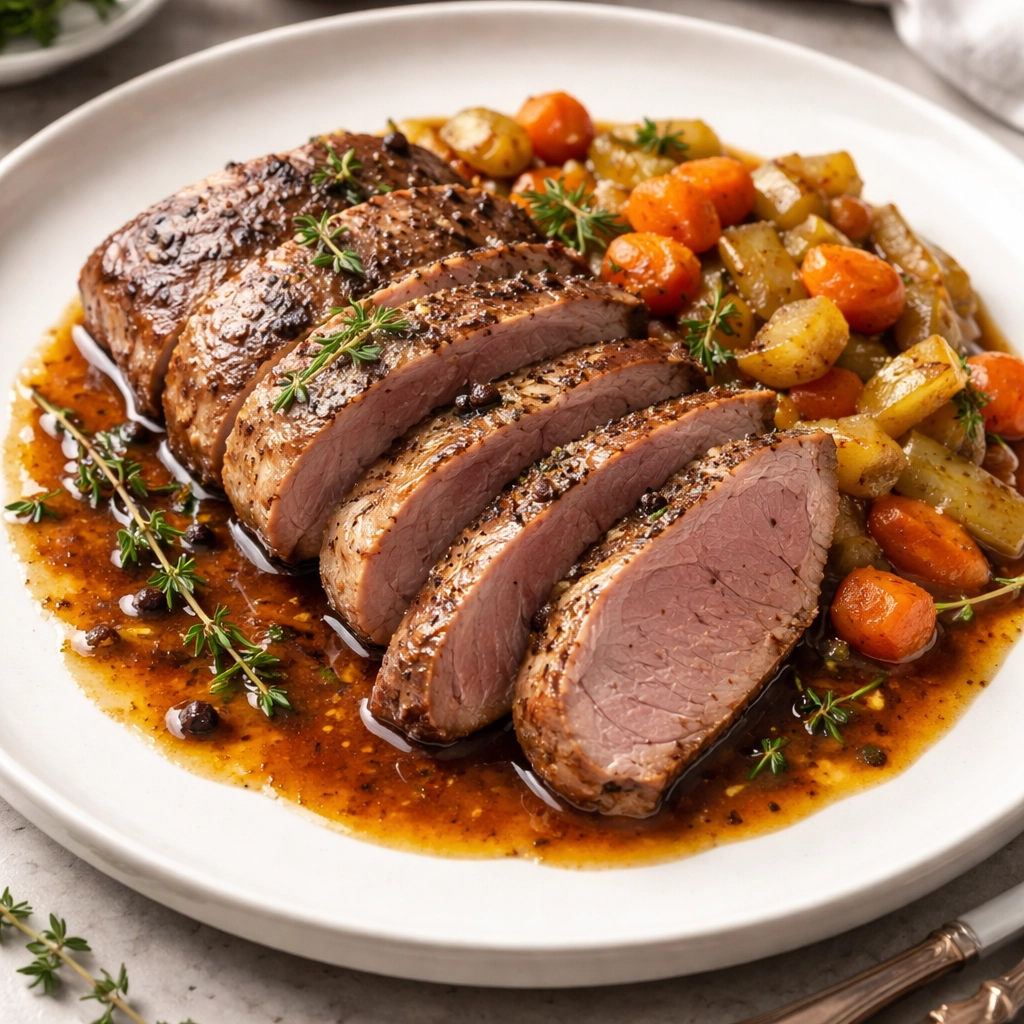
Wildschweinbraten
This Wildschweinbraten is deeply savoury, aromatic with juniper and thyme, and balanced by a glossy pan sauce enriched with sweet root vegetables. Using wild boar loin keeps the dish elegant and tender enough for a one-hour timetable while still delivering the rich, woodsy character expected from a classic game roast.
Nutrition · per serving
Ingredients
16 itemsFor the roast and seasoning
For the braising base
To finish
Tips
- •If you can find wild boar shoulder instead of loin, it needs a much longer braise and will not fit a 60-minute schedule; loin is the best advanced option for this timing.
- •Crushing juniper berries just before cooking gives a fresher piney aroma than using them pre-ground.
- •For the best texture, use an instant-read thermometer; game meat can go from juicy to dry quickly.
- •A side of roasted parsnips or mashed celeriac keeps the meal fully paleo.
Steps
- 1
Preheat the oven to 200°C. Pat the wild boar loin roast very dry for better browning. Lightly crush the juniper berries, strip most of the thyme leaves from the stems, and tear 1 bay leaf in half. Peel and cut the carrots, onion, and celery into 2 cm pieces, and finely slice the garlic.
500 g wild boar loin roast8 g juniper berries6 g fresh thyme2 bay leaves180 g carrots160 g yellow onion120 g celery stalks8 g garlic - 2
Season the roast all over with the fine sea salt and freshly ground black pepper. Rub it with half of the crushed juniper and half of the thyme leaves, pressing them onto the surface so they adhere.
500 g wild boar loin roast6 g fine sea salt2 g freshly ground black pepper8 g juniper berries6 g fresh thyme - 3
Heat a heavy ovenproof casserole or Dutch oven over medium-high heat. Add the ghee, then sear the roast for 2-3 minutes per side until deeply browned, including the ends. Remove to a plate; good colour here builds the finished sauce.
20 g ghee500 g wild boar loin roast - 4
Lower the heat to medium. Add the carrots, onion, celery, and garlic to the pot and sauté for 5-6 minutes until lightly caramelised. Stir in the tomato paste and cook for 1 minute until it darkens slightly and smells sweet rather than raw.
180 g carrots160 g yellow onion120 g celery stalks8 g garlic15 g tomato paste - 5
Deglaze with the apple cider vinegar, scraping up the browned bits from the bottom. Add the stock, the remaining crushed juniper, the remaining thyme, and the remaining bay leaf. Bring to a simmer.
10 ml apple cider vinegar350 ml beef or game stock8 g juniper berries6 g fresh thyme2 bay leaves - 6
Return the roast to the pot, nestling it among the vegetables so it sits partially submerged but not fully covered. Transfer uncovered to the oven and roast for 18-22 minutes, basting once halfway through, until the thickest part reaches 60-62°C for blush pink, or 65°C if you prefer it more done. Wild boar loin is lean, so avoid overcooking.
500 g wild boar loin roast - 7
Transfer the roast to a warm plate, loosely cover, and rest for 10 minutes. Meanwhile, strain the braising liquid, pressing on the vegetables to extract their flavour, then return the liquid to the pot and simmer over medium heat until slightly concentrated.
- 8
Mix the arrowroot starch with the cold water to make a smooth slurry. Whisk it into the simmering sauce a little at a time until lightly thickened and glossy; it should coat the back of a spoon, not become stodgy.
6 g arrowroot starch15 ml cold water - 9
Slice the rested wild boar roast across the grain. Spoon some sauce onto warm plates, arrange the slices on top, and serve with the braised vegetables alongside or spooned over.
500 g wild boar loin roast
Origin & History
Wildschweinbraten is part of the long German hunting and forest-cooking tradition, especially in regions where game has historically been central to autumn and winter tables. Juniper, bay, thyme, and root vegetables are classic seasonings for game in German-speaking Europe, used to complement the meat's robust, slightly sweet flavour. While older versions are often marinated for many hours and braised slowly, modern preparations sometimes use tender cuts for a faster roast.
Do even more with Gourmate
Cook this recipe in Gourmate — your AI meal planning app.
Plan Meals
Weekly planner at a tap
Ask Questions
Chat with your AI chef
Adjust Recipe
Scale servings & swap ingredients
Cook Mode
Step-by-step guidance
Kitchen Timers
Built-in timers & alerts
Grocery List
Auto-generated shopping lists