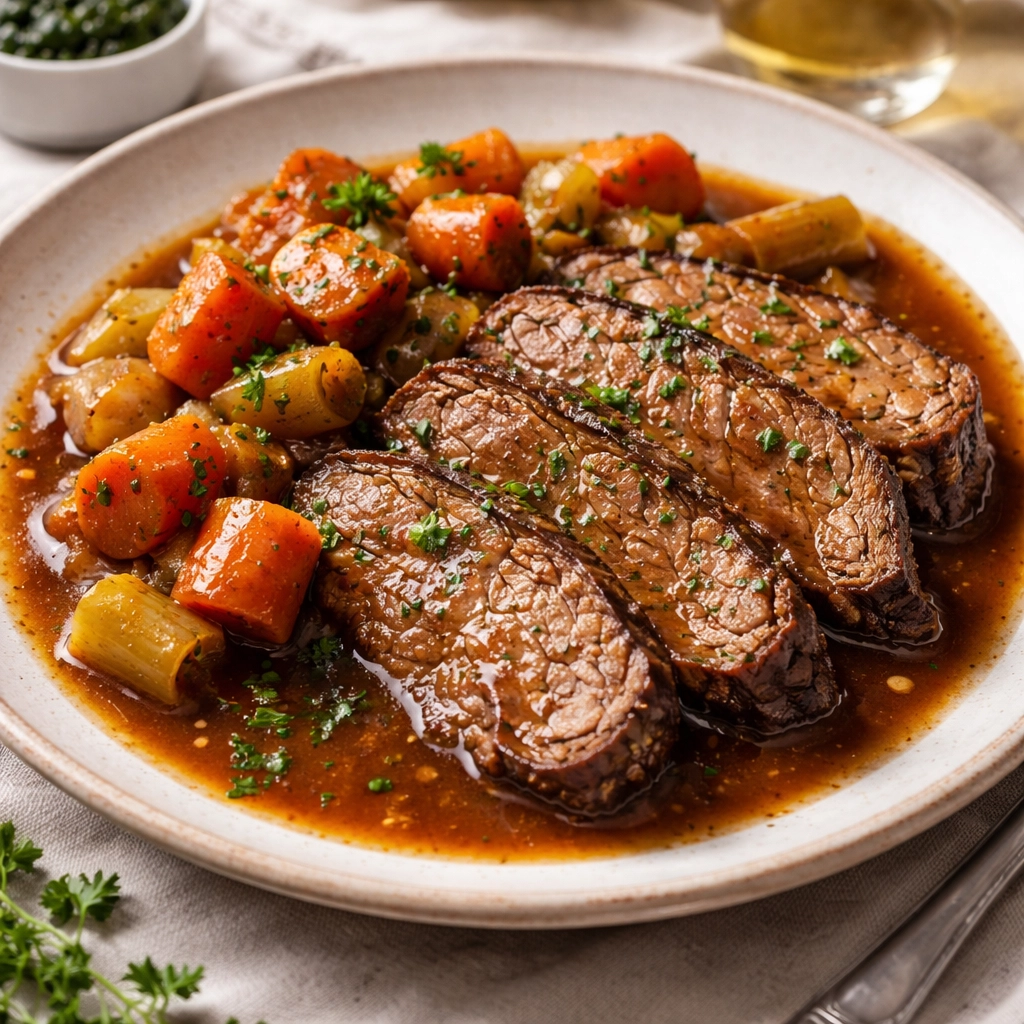
Rinderbraten
This Rinderbraten is deeply savory, with tender beef, sweet braised root vegetables, and a glossy wine-enriched sauce scented with thyme and bay. Using a smaller roast and careful heat control keeps the dish achievable in about an hour while still delivering the rich, slow-cooked character of the original.
Nutrition · per serving
Ingredients
17 itemsFür den Braten
Für das Schmorgemüse
Für den Schmorfond
Zum Fertigstellen
Tips
- •For a true 60-minute version, use a relatively small, thick 700 g chuck roast or well-marbled shoulder piece; larger traditional roasts need much longer to become tender.
- •If you have time, salting the beef 1-12 hours ahead improves seasoning and browning, but it is optional.
- •Red wine is traditional and authentic here; if you need a stricter paleo interpretation that avoids alcohol, replace it with additional stock plus 15 ml extra cider vinegar, though the flavor will be less classic.
- •Serve with roasted carrots, braised red cabbage without sugar, or cauliflower purée for a paleo-friendly plate.
Steps
- 1
Pat the beef dry very thoroughly, then season all over with the salt and black pepper. Let it stand at room temperature for 10 minutes while you prepare the vegetables; a dry surface helps the meat brown instead of steam.
700 g beef chuck roast, tied if needed8 g fine sea salt3 g freshly ground black pepper - 2
Heat a heavy casserole or Dutch oven over medium-high heat. Add the beef tallow, then sear the beef on all sides until deeply browned, about 6-8 minutes total. Do not move it too early; strong color builds the classic roasted flavor base. Transfer the beef to a plate.
20 g beef tallow or lard700 g beef chuck roast, tied if needed - 3
Lower the heat to medium. Add the carrots, celery, onion, and garlic to the pot and cook for 5-6 minutes, stirring occasionally, until the vegetables take on golden edges. Stir in the tomato paste and cook for 1 minute more until it darkens slightly; this removes raw acidity and deepens the sauce.
180 g carrots, peeled and cut into 2 cm pieces120 g celery stalks, cut into 2 cm pieces180 g yellow onion, cut into wedges12 g garlic cloves, lightly crushed15 g tomato paste - 4
Pour in the red wine and scrape the bottom of the pot thoroughly to dissolve the browned bits. Simmer briskly for 4-5 minutes until reduced by about one-third; this concentrates flavor and cooks off the harsh alcohol edge.
250 ml dry red wine - 5
Return the beef and any collected juices to the pot. Add the beef stock, thyme, bay leaves, and apple cider vinegar. The liquid should come roughly halfway up the meat, not fully cover it. Bring just to a simmer.
700 g beef chuck roast, tied if needed300 ml beef stock, unsalted6 g fresh thyme sprigs2 bay leaves10 ml apple cider vinegar - 6
Cover with a tight-fitting lid and braise at a gentle simmer on the stovetop or in a preheated 180°C oven for about 30 minutes, turning the meat once halfway through. For this 2-serving, smaller roast size, start checking early: it is ready when a fork slides in with little resistance but the slices still hold together.
700 g beef chuck roast, tied if needed - 7
Transfer the beef to a warm plate, loosely cover, and rest for 10 minutes. Meanwhile, remove and discard the thyme stems and bay leaves from the pot. For a classic, refined finish, blend the braising vegetables and liquid until smooth, or mash them well for a rustic sauce.
700 g beef chuck roast, tied if needed6 g fresh thyme sprigs2 bay leaves - 8
Mix the arrowroot powder with the cold water to make a smooth slurry. Bring the sauce to a simmer and whisk in the slurry a little at a time until lightly thickened and glossy, about 1 minute. Arrowroot should not be boiled hard for long, or it can thin again.
6 g arrowroot powder15 ml cold water - 9
Slice or chunk the rested beef against the grain. Spoon over the sauce, scatter with parsley, and serve immediately with some of the braised vegetables and sauce alongside.
700 g beef chuck roast, tied if needed8 g fresh parsley, finely chopped
Origin & History
Rinderbraten is a classic German Sunday roast, traditionally made by slowly braising beef with root vegetables, stock, and often wine until tender. Regional versions vary across Germany, with some using vinegar, juniper, or darker gravies, but the heart of the dish is the same: economical cuts transformed by patient cooking into a rich, comforting meal.
Do even more with Gourmate
Cook this recipe in Gourmate — your AI meal planning app.
Plan Meals
Weekly planner at a tap
Ask Questions
Chat with your AI chef
Adjust Recipe
Scale servings & swap ingredients
Cook Mode
Step-by-step guidance
Kitchen Timers
Built-in timers & alerts
Grocery List
Auto-generated shopping lists