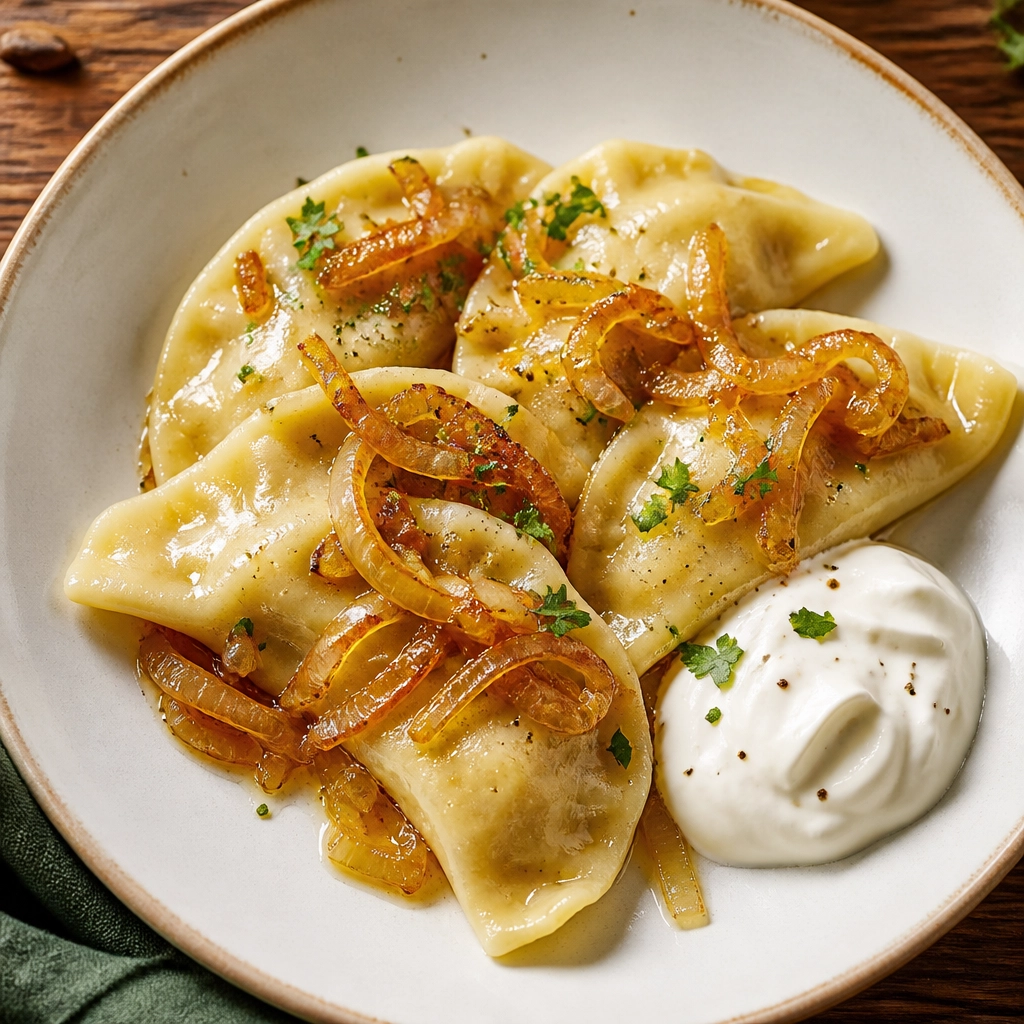
Pierogi ruskie
These tender boiled dumplings are filled with a creamy, savory mixture of potato, twaróg, and sweet onion. Finished with buttery caramelised onion and cool sour cream, they are comforting, rich, and deeply satisfying.
Nutrition · per serving
Ingredients
16 itemsDough
Filling
To finish
Tips
- •For the best traditional texture, use floury potatoes such as Maris Piper or King Edward; waxy potatoes make the filling gummy.
- •Twaróg can be replaced with well-drained farmer's cheese or quark if needed, but authentic pierogi ruskie are best with twaróg.
- •If you have scraps of dough, gather and reroll them once; repeated rerolling makes the dough tougher.
- •These pierogi are also excellent pan-fried in a little butter the next day until lightly crisp.
Steps
- 1
Bring a medium pot of salted water to the boil for the potatoes. At the same time, start the dough: mix the plain flour and fine salt in a bowl, add the egg, warm water, and neutral oil, then knead for 6-8 minutes until smooth and elastic. If it feels sticky, dust very lightly with flour; if dry, wet your hands and keep kneading. Cover and let it rest while you make the filling.
200 g plain flour2 g fine salt1 medium egg90 ml warm water10 ml neutral oil - 2
Add the floury potatoes to the boiling water and cook for 12-15 minutes until completely tender; a knife should slide in easily with no resistance. Drain very well so the filling stays firm.
300 g floury potatoes, peeled and diced - 3
While the potatoes cook, melt the butter in a frying pan over medium heat. Add the finely diced yellow onion and cook for 8-10 minutes, stirring often, until soft and lightly golden rather than dark brown; gentle browning keeps the filling sweet. Set aside to cool slightly.
120 g yellow onion, finely diced20 g butter - 4
Mash the drained potatoes until dry and mostly smooth. Crumble in the twaróg cheese, add the cooked onion, fine salt, and freshly ground black pepper, then mix thoroughly. Taste and adjust seasoning; the filling should be distinctly peppery and savory. Let it cool for a few minutes so it is easier to shape.
300 g floury potatoes, peeled and diced200 g twaróg cheese120 g yellow onion, finely diced20 g butter3 g fine salt2 g freshly ground black pepper - 5
For the topping, melt the butter in the same pan over medium-low heat. Add the thinly sliced yellow onion and cook for 10-12 minutes, stirring regularly, until deeply golden and caramelised. Season lightly with fine salt and freshly ground black pepper. Keep warm on low heat.
120 g yellow onion, thinly sliced25 g butter1 g fine salt1 g freshly ground black pepper - 6
Roll the rested dough on a lightly floured surface to about 2 mm thick. Cut out rounds 7-8 cm across. Place about 1 heaped teaspoon of filling in the centre of each round, fold into half-moons, and pinch firmly to seal, pushing out any trapped air. Keep the finished pierogi covered with a towel so they do not dry out.
200 g plain flourall prepared filling Filling - 7
Bring a wide pot of lightly salted water to a gentle boil. Cook the pierogi in batches for 2-3 minutes after they float to the surface. Do not overcrowd the pot or they may stick and cool the water too much. Lift out with a slotted spoon and drain briefly.
- 8
Plate the pierogi, spoon over the caramelised onion and butter, and serve immediately with sour cream on the side or dolloped over the top.
120 g yellow onion, thinly sliced25 g butter80 g sour cream
Origin & History
Pierogi ruskie are one of Poland's best-known dumplings, filled with potato, fresh white cheese, and onion. Despite the name, "ruskie" refers historically to Red Ruthenia, a region once linked to the eastern borderlands, not to Russia. They became a staple of home cooking because the ingredients were affordable, filling, and widely available.
Do even more with Gourmate
Cook this recipe in Gourmate — your AI meal planning app.
Plan Meals
Weekly planner at a tap
Ask Questions
Chat with your AI chef
Adjust Recipe
Scale servings & swap ingredients
Cook Mode
Step-by-step guidance
Kitchen Timers
Built-in timers & alerts
Grocery List
Auto-generated shopping lists