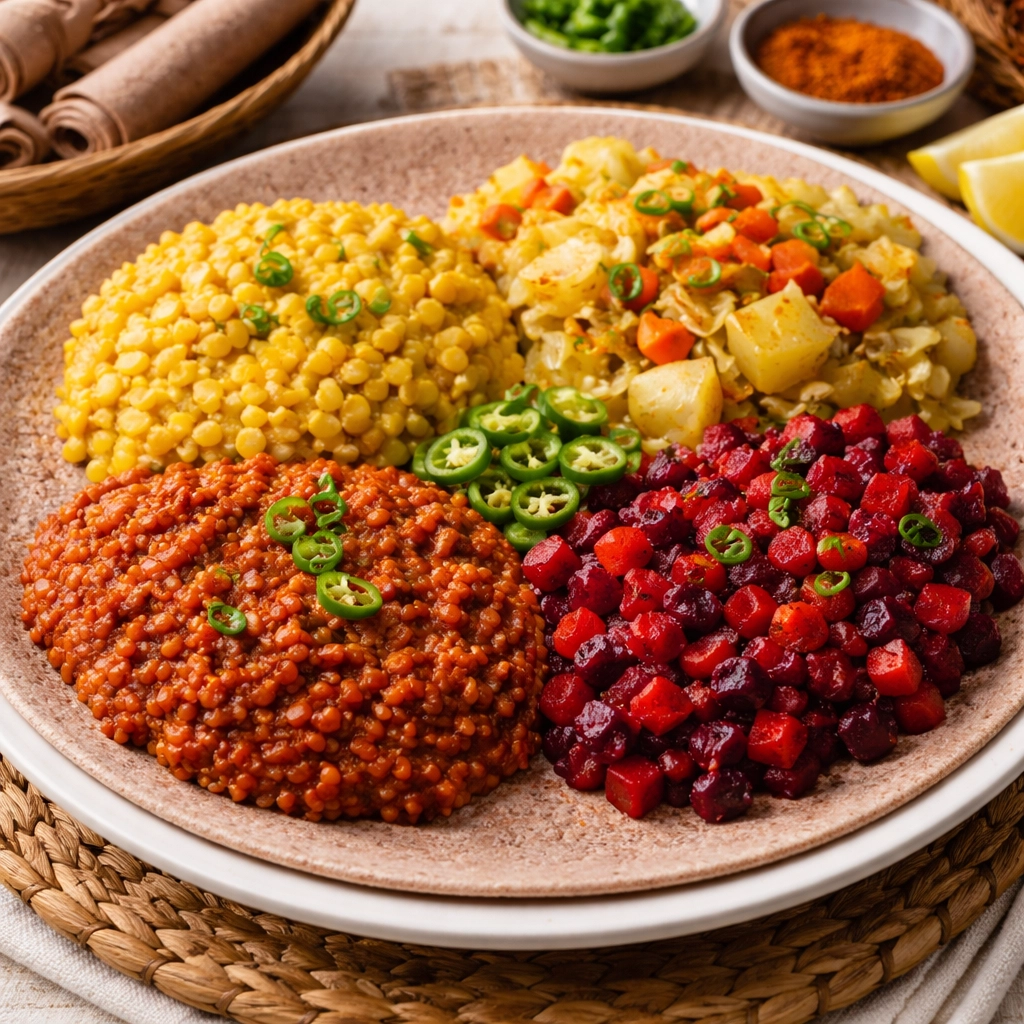
Beyaynetu
Beyaynetu is a vibrant injera platter layered with contrasting vegan stews and braises: spicy misir wot, mild and creamy kik alicha, tender cabbage and potato atkilt wat, and sweet earthy beets. The result is a deeply satisfying meal with tangy bread, warm spices, and a beautiful balance of heat, sweetness, and savoriness.
Nutrition · per serving
Ingredients
37 itemsMisir Wot
Kik Alicha
Atkilt Wat
Key Sir Alicha
For Serving
Tips
- •Using small dice for the beetroot and potato is essential to keep the full platter within 60 minutes.
- •If you have niter kibbeh on hand, it is traditional in some versions, but this vegan platter uses neutral oil for fasting days.
- •Berbere blends vary in heat; start with 8 g if yours is very spicy and add more to taste.
- •For the most authentic experience, eat with your hands by tearing pieces of injera and using them to scoop the stews.
Steps
- 1
Rinse the yellow split peas and red lentils separately under cold water until the water runs mostly clear. Prep all vegetables: finely chop and slice the onions, mince the garlic, grate the ginger, shred the cabbage, and cut the carrot, potato, and beetroot into small even pieces so they cook quickly and evenly.
120 g yellow split peas120 g red lentils120 g red onion, finely chopped80 g red onion, finely chopped70 g red onion, thinly sliced60 g red onion, finely chopped10 g garlic, minced8 g garlic, minced6 g garlic, minced5 g garlic, minced10 g ginger, grated8 g ginger, grated6 g ginger, grated5 g ginger, grated250 g green cabbage, shredded120 g carrot, sliced thinly80 g carrot, diced small180 g potato, diced small200 g beetroot, peeled and diced small - 2
Start the kik alicha first. In a saucepan over medium heat, cook the red onion in the oil for 3-4 minutes until softened but not browned. Add the garlic, ginger, and turmeric; stir for 30 seconds until fragrant. Add the yellow split peas, water, and salt. Bring to a boil, then reduce to a gentle simmer and cook for 28-32 minutes, stirring occasionally, until the peas are very tender and the mixture is thick but spoonable. Add a splash more water if it tightens too much.
80 g red onion, finely chopped15 ml neutral oil8 g garlic, minced8 g ginger, grated3 g turmeric120 g yellow split peas450 ml water3 g salt - 3
At the same time, make the misir wot. In a second pan over medium heat, cook the onion in the oil for 4-5 minutes until soft and lightly golden; patient onion cooking builds sweetness. Stir in the garlic and ginger for 30 seconds, then add the berbere and tomato paste and cook for 1 minute to bloom the spices without scorching them. Add the red lentils, water, and salt. Simmer for 18-22 minutes, stirring often toward the end, until the lentils collapse into a thick, rich stew.
120 g red onion, finely chopped15 ml neutral oil10 g garlic, minced10 g ginger, grated12 g berbere15 g tomato paste120 g red lentils350 ml water3 g salt - 4
For the atkilt wat, heat the oil in a wide pan over medium heat. Add the onion and cook 3 minutes until softened. Add the garlic, ginger, and turmeric and stir briefly. Add the cabbage, sliced carrot, potato, water, and salt. Cover and cook for 14-16 minutes, stirring once or twice, until the potatoes are tender and the cabbage is silky but not mushy. Uncover for the last few minutes if excess moisture needs to evaporate.
15 ml neutral oil70 g red onion, thinly sliced6 g garlic, minced6 g ginger, grated2 g turmeric250 g green cabbage, shredded120 g carrot, sliced thinly180 g potato, diced small120 ml water3 g salt - 5
For the key sir alicha, heat the oil in a small saucepan over medium heat. Cook the onion for 3 minutes until soft, then add the garlic and ginger for 30 seconds. Add the beetroot, diced carrot, water, and salt. Cover and simmer for 16-18 minutes until the beetroot is tender but still holds its shape. The vegetables should be moist, not soupy.
10 ml neutral oil60 g red onion, finely chopped5 g garlic, minced5 g ginger, grated200 g beetroot, peeled and diced small80 g carrot, diced small120 ml water2 g salt - 6
Taste all four preparations and adjust salt if needed. If the misir wot becomes too thick, loosen it with a spoonful of hot water; if the kik alicha is still firm, cook a few minutes longer until creamy. Warm the injera briefly, covered, so it stays soft and pliable.
4 large pieces (about 400 g) injera - 7
To serve, line a large platter or two dinner plates with the injera. Arrange mounds of misir wot, kik alicha, atkilt wat, and key sir alicha over the injera, spacing them apart in the traditional mixed-platter style. Garnish with sliced green chilli and serve immediately with the remaining injera for tearing and scooping.
4 large pieces (about 400 g) injera10 g fresh green chilli, sliced
Origin & History
Beyaynetu is a classic Ethiopian and Eritrean platter whose name means roughly 'a bit of everything.' It is especially associated with fasting days in the Ethiopian Orthodox tradition, when richly spiced vegan dishes such as lentils, split peas, and vegetables are served together over injera.
Do even more with Gourmate
Cook this recipe in Gourmate — your AI meal planning app.
Plan Meals
Weekly planner at a tap
Ask Questions
Chat with your AI chef
Adjust Recipe
Scale servings & swap ingredients
Cook Mode
Step-by-step guidance
Kitchen Timers
Built-in timers & alerts
Grocery List
Auto-generated shopping lists