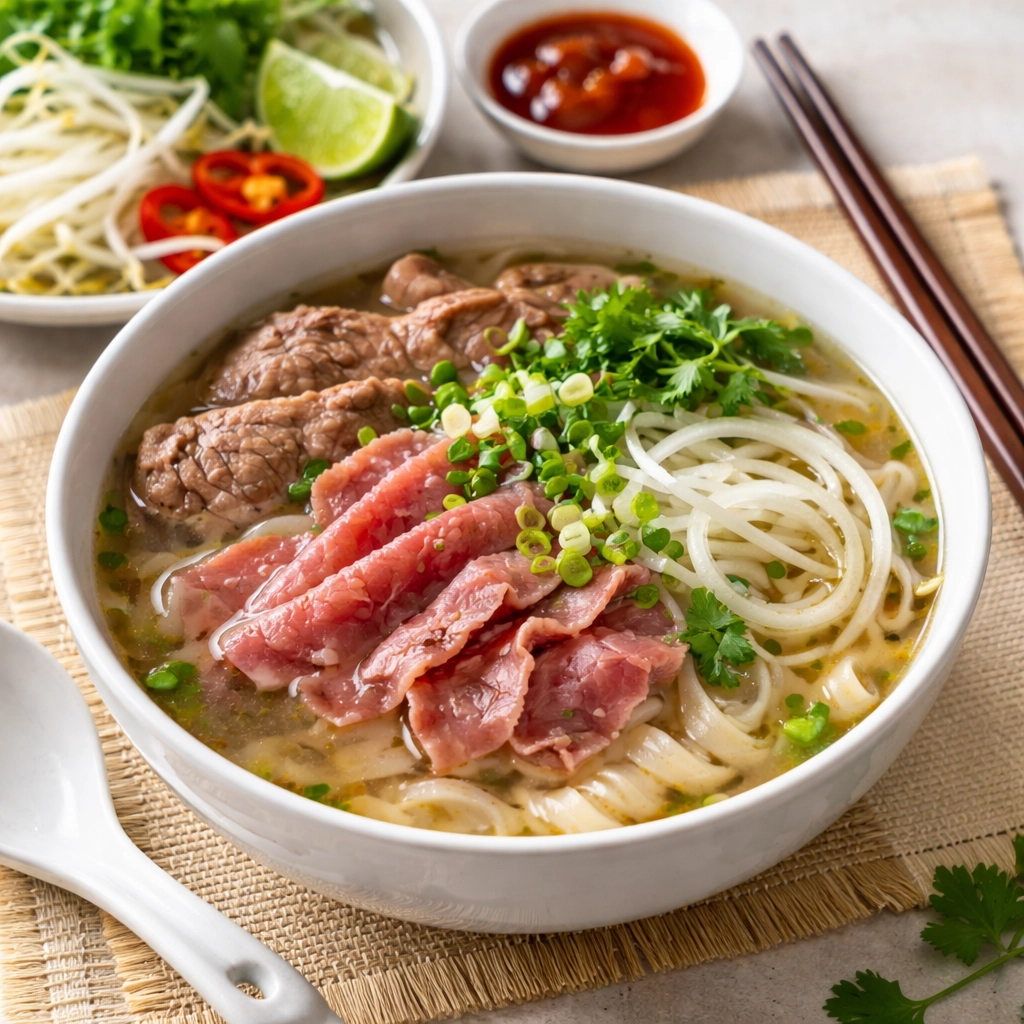
Phở Bò
Phở bò is a fragrant bowl of clear beef broth layered with warm spices, silky rice noodles, and tender slices of beef. The broth is light yet deeply savory, while fresh herbs, sprouts, lime, and chili bring brightness, crunch, and aroma to every spoonful.
Nutrition · per serving
Ingredients
21 itemsNước dùng
Mì và thịt
Phần ăn kèm
Tips
- •This is a streamlined restaurant-style home method designed to fit 60 minutes; a traditional broth is often simmered for many hours and will taste deeper, but blanching bones, charring aromatics, and using a small piece of beef in the broth gives excellent results fast.
- •For the cleanest flavor, keep the broth at a bare simmer, never a rolling boil after the initial boil.
- •If slicing the raw beef is difficult, freeze it for a little longer and use a very sharp knife.
- •Warm the serving bowls with hot water before assembling so the broth stays piping hot enough to gently cook the raw beef.
- •Hoisin and sriracha are common table condiments in some settings, but classic phở is best tasted first with only lime, herbs, and chili.
Steps
- 1
Freeze the serving beef for 20 minutes so it firms up for easier slicing. Meanwhile, rinse the bones under cold water. Put the bones in a pot, cover with cold water, bring to a hard boil for 5 minutes, then drain and rinse the bones clean. Wash out the pot. This quick blanch is the fastest way to keep the broth clear within the 60-minute limit.
800 g beef marrow or knuckle bones2.2 L water120 g sirloin or eye of round beef, very thinly sliced for serving - 2
While the bones blanch, char the onion and ginger cut-side down in a dry pan over high heat until deeply blackened in spots, 4-6 minutes. In the same pan, toast the star anise, cinnamon, cloves, and coriander seeds for 30-60 seconds until fragrant; do not let them burn or the broth will taste bitter.
1 medium (150 g) onion, halved60 g ginger, halved lengthwise2 whole star anise1 small (5 g) cinnamon stick3 whole cloves1 tsp (2 g) coriander seeds - 3
Return the cleaned bones to the pot with 2.2 L fresh water. Add the charred onion, charred ginger, toasted spices, fish sauce, sugar, salt, and the 250 g piece of beef for the broth. Bring just to a boil, then immediately reduce to a very gentle simmer. Skim frequently for the first 10 minutes to keep the stock clear. Simmer until the broth tastes full and the beef piece is tender, about 30 minutes.
800 g beef marrow or knuckle bones2.2 L water1 medium (150 g) onion, halved60 g ginger, halved lengthwise2 whole star anise1 small (5 g) cinnamon stick3 whole cloves1 tsp (2 g) coriander seeds30 ml fish sauce8 g rock sugar or white sugar5 g fine salt250 g sirloin or eye of round beef, for broth and serving - 4
Remove the 250 g beef piece from the broth once just tender; let it cool slightly, then slice thinly for the bowls. Strain the broth through a fine sieve into a clean pot, pressing gently on the solids but not forcing sediment through. Taste and adjust with a few extra drops of fish sauce or a pinch of salt if needed. Keep the broth at a near-boil so it can cook the raw sliced beef in the bowls.
250 g sirloin or eye of round beef, for broth and serving30 ml fish sauce5 g fine salt - 5
Soak or cook the rice noodles according to their thickness: either soak in hot water until pliable, then boil briefly, or boil directly until just tender, usually 2-4 minutes. Rinse very briefly only if they are excessively starchy, then drain well. Overcooked noodles will turn mushy once the broth is added.
140 g dried flat rice noodles - 6
Slice the partially frozen serving beef as thinly as possible across the grain. Arrange the spring onions, white onion, bean sprouts, Thai basil, cilantro, lime wedges, and chili for serving.
120 g sirloin or eye of round beef, very thinly sliced for serving2 spring onions, thinly sliced60 g white onion, very thinly sliced120 g bean sprouts15 g Thai basil10 g cilantro1 lime, cut into wedges1 red chili, thinly sliced - 7
Divide the noodles between 2 warmed bowls. Top with the sliced cooked beef, then the raw thinly sliced beef, spring onions, and white onion. Ladle the boiling-hot broth over the top so the raw beef turns just pink-to-brown at the edges. Serve immediately with bean sprouts, basil, cilantro, lime, and chili on the side so each person can season their bowl to taste.
140 g dried flat rice noodles250 g sirloin or eye of round beef, for broth and serving120 g sirloin or eye of round beef, very thinly sliced for serving2 spring onions, thinly sliced60 g white onion, very thinly sliced120 g bean sprouts15 g Thai basil10 g cilantro1 lime, cut into wedges1 red chili, thinly sliced
Origin & History
Phở bò is one of Vietnam’s most iconic noodle soups, developed in northern Vietnam in the early 20th century around Hanoi. It reflects both local culinary traditions and historical influences, especially in the use of beef and long-simmered stock, before spreading throughout the country in many regional styles.
Do even more with Gourmate
Cook this recipe in Gourmate — your AI meal planning app.
Plan Meals
Weekly planner at a tap
Ask Questions
Chat with your AI chef
Adjust Recipe
Scale servings & swap ingredients
Cook Mode
Step-by-step guidance
Kitchen Timers
Built-in timers & alerts
Grocery List
Auto-generated shopping lists