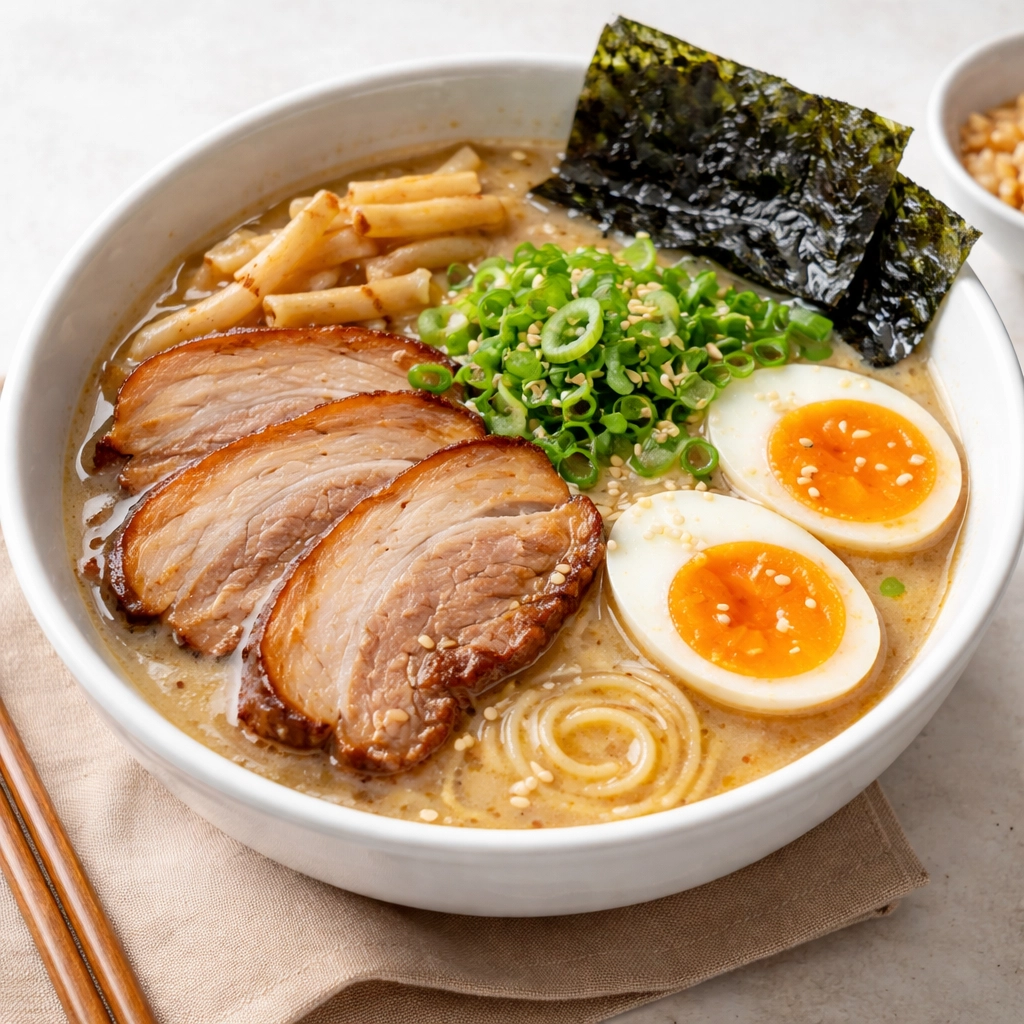
Tonkotsu Ramen
This bowl delivers a creamy, collagen-rich pork broth with deep savoury aroma, springy noodles, tender slices of chashu, and a jammy egg. Menma, nori, and sesame add contrast and texture, making it feel like a classic ramen-shop bowl despite the accelerated technique.
Nutrition · per serving
Ingredients
23 itemsQuick tonkotsu broth
Chashu pork
Shoyu tare
Eggs and noodles
Toppings for serving
Tips
- •This 60-minute version uses a pressure cooker to create a convincing quick tonkotsu; traditional tonkotsu usually simmers hard for many hours.
- •Ask your butcher to split the pork bones small; more exposed surface area gives better extraction and a milkier broth fast.
- •Fresh ramen noodles are strongly recommended here because dried noodles rarely deliver the same springy texture in a classic bowl.
- •If you want a richer finish, whisk 1 to 2 tablespoons of hot rendered fat from the chashu braise into the strained broth before serving.
Steps
- 1
Start the broth first. Put the pork back bones, cold water, garlic, ginger, and spring onions into a pressure cooker. Lock the lid and bring to high pressure; cook for 35 minutes. Quick-release carefully, then uncover and boil vigorously for 10 minutes to emulsify the fat and collagen into a creamy broth. Skim only obvious scum, not the fat, then strain. You should have about 1 litre of opaque broth; if much more, boil briefly to reduce, and if less, top up with hot water.
1.2 kg pork back bones, cut small2.5 L cold water6 garlic cloves, smashed40 g fresh ginger, sliced2 spring onions, roughly chopped - 2
While the broth cooks, make the chashu. Heat the neutral oil in a saucepan over medium-high heat and sear the pork belly on all sides until lightly browned; this adds depth even in a short braise. Add the water, soy sauce, mirin, sugar, ginger, and garlic. Bring to a simmer, cover, and cook gently for 25 minutes, turning once halfway, until the pork is tender but still sliceable.
10 ml neutral oil300 g boneless pork belly, rolled or tied300 ml water60 ml soy sauce40 ml mirin15 g sugar10 g fresh ginger, sliced2 garlic cloves, smashed - 3
Remove the pork belly from the braising liquid and rest for 10 minutes so it slices cleanly. Keep a little of the braising liquid for brushing or spooning over the pork at serving.
300 g boneless pork belly, rolled or tied - 4
Make the tare in a small pan: combine the soy sauce, mirin, sake, and sugar, bring just to a simmer, and cook for 1 minute to dissolve the sugar and round off the alcohol. Set aside.
80 ml soy sauce20 ml mirin20 ml sake8 g sugar - 5
Cook the eggs in boiling water for 6½ minutes for jammy centres, then transfer immediately to ice water or very cold water. Peel carefully once cool enough to handle and halve just before serving.
2 large eggs - 6
Bring a pot of water to a rolling boil and cook the fresh ramen noodles until just springy, usually 1 to 2 minutes. Stir early to prevent clumping, then drain thoroughly so the soup is not diluted.
280 g fresh ramen noodles - 7
Slice the rested chashu. Warm the menma if you like, and prepare the nori, sliced spring onion, and sesame seeds for quick assembly.
80 g menma (seasoned bamboo shoots), drained2 half-sheets nori sheets1 spring onion, finely sliced10 g toasted sesame seeds300 g boneless pork belly, rolled or tied - 8
Assemble each bowl: add half the tare to each bowl, then ladle in the hot tonkotsu broth and stir. Add half the noodles to each bowl, then top with sliced chashu, a halved soft-boiled egg, menma, nori, spring onion, and sesame seeds. Serve immediately while the broth is piping hot and the noodles are still bouncy.
280 g fresh ramen noodles300 g boneless pork belly, rolled or tied2 large eggs80 g menma (seasoned bamboo shoots), drained2 half-sheets nori sheets1 spring onion, finely sliced10 g toasted sesame seeds80 ml soy sauce20 ml mirin20 ml sake8 g sugar
Origin & History
Tonkotsu ramen originated in Fukuoka on Japan's Kyushu island, where cooks developed a pork-bone broth boiled until richly opaque and deeply savoury. The style became famous for its creamy white soup, thin noodles, and customizable toppings, and it remains one of Japan's most iconic ramen traditions.
Do even more with Gourmate
Cook this recipe in Gourmate — your AI meal planning app.
Plan Meals
Weekly planner at a tap
Ask Questions
Chat with your AI chef
Adjust Recipe
Scale servings & swap ingredients
Cook Mode
Step-by-step guidance
Kitchen Timers
Built-in timers & alerts
Grocery List
Auto-generated shopping lists