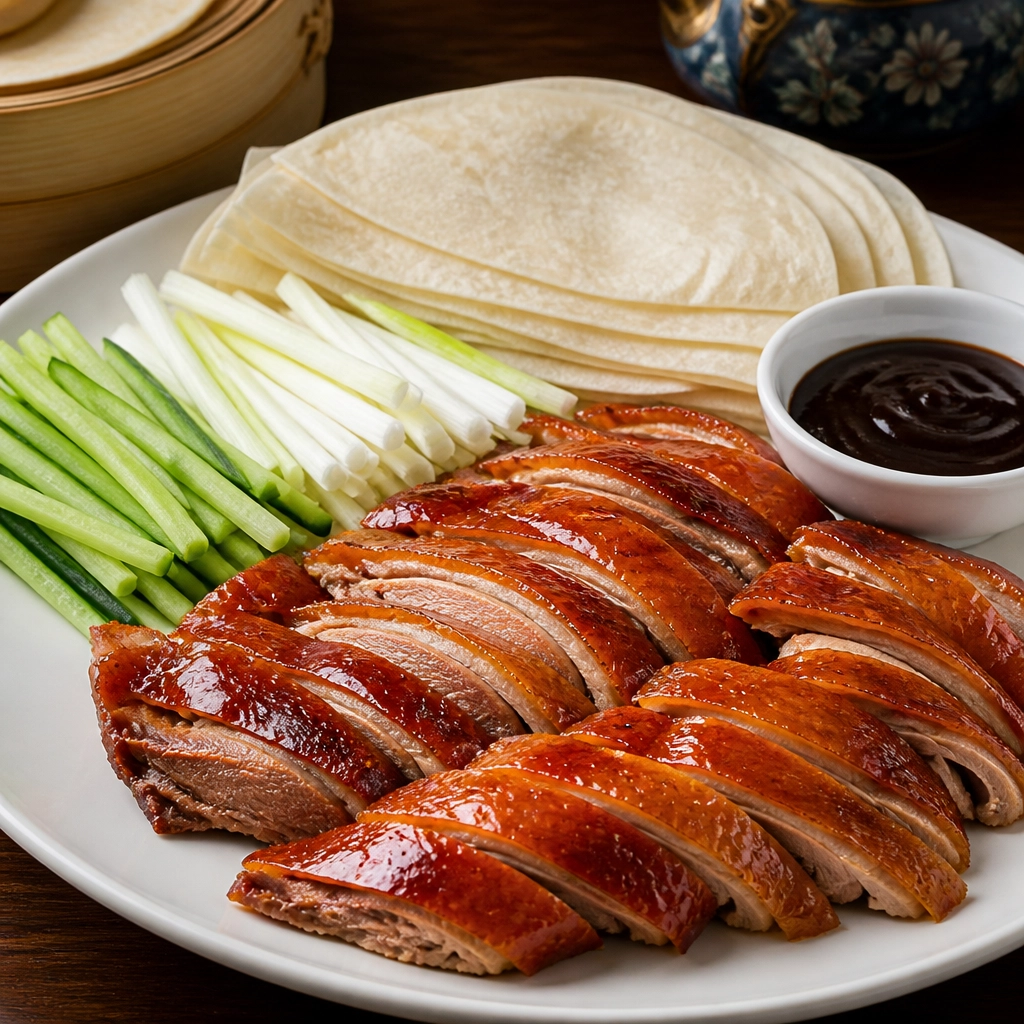
Peking Duck
Peking Duck is prized for its glossy, crackling skin and succulent slices of richly flavored duck wrapped in soft pancakes. With cool cucumber, sharp spring onion, and sweet-savory hoisin, each bite is a perfect balance of crisp, tender, fresh, and aromatic.
Nutrition · per serving
Ingredients
13 itemsDuck and lacquer
Pancakes and accompaniments
To serve
Tips
- •A traditional Peking duck usually dries for many hours or overnight; this 60-minute version uses a smaller duck, scalding, and a brief air-dry to achieve very good crispness in limited time.
- •For the best results, choose a young, small duck with intact skin and roast it on a rack so hot air can circulate.
- •If the duck browns too quickly, loosely tent the darkest areas with foil during the final part of roasting.
- •Any leftover carcass can be simmered with ginger and spring onion for a light soup.
Steps
- 1
Pat the whole duck very dry inside and out. Trim any excess fat from the cavity opening and tuck the wing tips behind the back. Bring the boiling water to a full boil if needed, then slowly ladle it all over the duck over a rack set in the sink; the skin will tighten immediately. This scalding helps the skin dry and roast more evenly.
1 small whole duck, about 1.6 kg whole duck1.5 litres boiling water - 2
In a bowl, whisk together the maltose, light soy sauce, dark soy sauce, Shaoxing wine, rice vinegar, five-spice powder, and fine salt. If the maltose is stiff, warm the bowl briefly over hot water so it dissolves smoothly. Brush this lacquer all over the duck, including under the wings and around the legs, for an even glossy coating.
40 g maltose20 ml light soy sauce10 ml dark soy sauce15 ml Shaoxing wine20 ml rice vinegar2 g five-spice powder6 g fine salt1 small whole duck, about 1.6 kg whole duck - 3
Set the duck breast-side up on a rack over a tray and leave it uncovered in a cool, airy spot or in front of a fan for 15 minutes while you heat the oven to 220°C. This short drying time is a practical fast-track version; the skin should look tacky rather than wet before roasting.
1 small whole duck, about 1.6 kg whole duck - 4
Roast the duck at 220°C for 15 minutes to start rendering the fat and setting the lacquer. Reduce the oven to 180°C and roast for 25 more minutes, turning the tray once for even coloring. The skin should become deep mahogany and crisp in patches, and the thickest part of the thigh should reach at least 74°C.
1 small whole duck, about 1.6 kg whole duck - 5
While the duck roasts, cut the cucumber into 6-7 cm fine batons and shred the spring onions into thin lengths. Keep them chilled so they stay crisp.
150 g cucumber80 g spring onions - 6
Warm the Mandarin pancakes according to their type: steam for 5 minutes or microwave briefly under a damp cloth until soft and pliable. Keep them covered so they do not dry out.
12 small Mandarin pancakes - 7
Rest the duck on a board for 5 minutes. Resting lets the juices settle and the skin firm slightly, making it easier to carve cleanly.
1 small whole duck, about 1.6 kg whole duck - 8
Carve the duck by slicing off the crisp skin in large pieces first, then cutting the breast and leg meat into thin slices. Try to keep some skin attached to the meat for the best texture in each pancake.
1 small whole duck, about 1.6 kg whole duck - 9
Serve immediately with warm Mandarin pancakes, cucumber, spring onions, and hoisin sauce. To eat, spread a little hoisin on a pancake, add duck, cucumber, and spring onion, then roll tightly.
12 small Mandarin pancakes150 g cucumber80 g spring onions120 g hoisin sauce
Origin & History
Peking Duck is one of China's most celebrated banquet dishes, associated especially with Beijing and imperial court cooking from the Ming dynasty onward. Traditionally, the duck is air-dried and roasted until the skin is lacquered and crisp, then served with pancakes and condiments at the table. Its elaborate preparation made it a symbol of refinement and hospitality.
Do even more with Gourmate
Cook this recipe in Gourmate — your AI meal planning app.
Plan Meals
Weekly planner at a tap
Ask Questions
Chat with your AI chef
Adjust Recipe
Scale servings & swap ingredients
Cook Mode
Step-by-step guidance
Kitchen Timers
Built-in timers & alerts
Grocery List
Auto-generated shopping lists