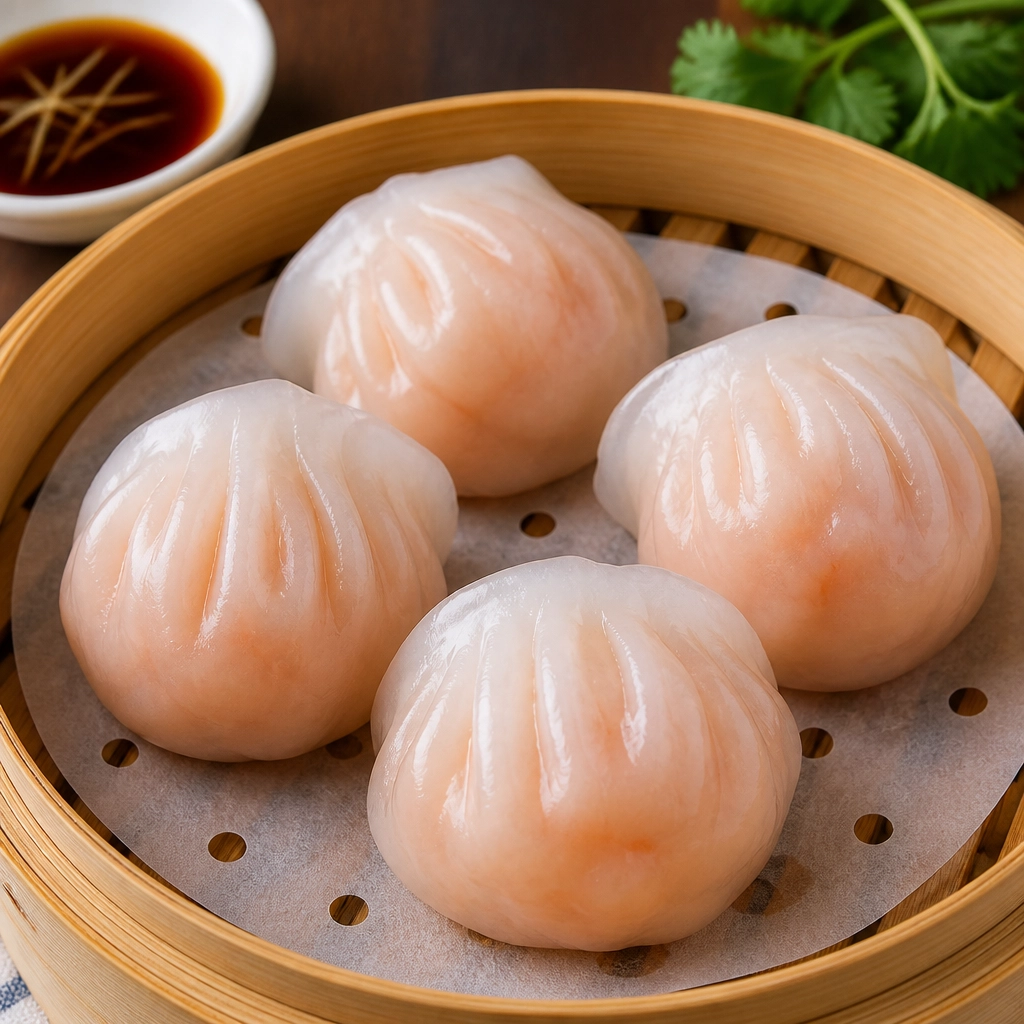
Har Gow
Har gow are elegant steamed prawn dumplings with a glossy, translucent skin and a juicy filling scented with ginger and sesame oil. When made well, the wrapper is tender yet pleasantly chewy, enclosing sweet prawns and crisp bamboo shoot in every bite.
Nutrition · per serving
Ingredients
16 itemsPrawn filling
Translucent dough
For shaping and steaming
Tips
- •For the best texture, use very fresh prawns and do not puree the entire filling; some chopped pieces give the characteristic springy bite.
- •Wheat starch dough must be worked warm. If it cools and becomes brittle, knead briefly with slightly warm hands rather than adding much extra water.
- •A metal bench scraper or flat knife can help lift the thin wrappers without tearing.
- •Har gow are traditionally served plain or with a very light soy-based dip, but heavy dipping sauces can overpower their delicate sweetness.
Steps
- 1
Bring a kettle to a full boil and set up a steamer with enough water underneath, but do not start steaming yet. Lightly brush a plate or steamer liner with oil so the dumplings will not stick. If using bamboo steamer paper, punch a few holes for steam circulation.
5 ml neutral oil, for brushing1.5 litres water, for steamer - 2
Make the filling: reserve about one-third of the prawns and cut them into 5 mm pieces for texture. Finely chop the remaining prawns into a rough paste, then combine with the diced prawns, bamboo shoots, ginger, sesame oil, oyster sauce, salt, white pepper, sugar, and cornstarch. Stir vigorously in one direction for 1 to 2 minutes until the mixture becomes slightly sticky and cohesive; this helps the filling hold together. Chill for 10 minutes while you prepare the dough.
220 g raw peeled prawns, deveined40 g bamboo shoots, finely diced6 g ginger, very finely grated5 ml sesame oil8 ml oyster sauce1.5 g fine salt0.5 g white pepper2 g sugar6 g cornstarch - 3
Make the dough: mix the wheat starch, tapioca starch, and salt in a heatproof bowl. Pour in the boiling water all at once and immediately stir with chopsticks or a sturdy spoon until shaggy clumps form. When cool enough to handle but still very warm, add the oil and knead until smooth, pliable, and slightly translucent, about 2 to 3 minutes. If it feels dry, wet your hands very lightly; if too sticky, dust with a little wheat starch.
120 g wheat starch35 g tapioca starch1 g fine salt145 ml boiling water10 ml neutral oil - 4
Divide the warm dough into 10 equal pieces and keep them covered with an overturned bowl or lightly damp cloth so they do not dry out; this dough is easiest to work while warm.
- 5
Shape the wrappers one at a time: roll each piece into a ball, then flatten it between two lightly oiled pieces of baking paper or plastic into a thin circle about 8 to 9 cm wide, leaving the centre slightly thicker than the edge. This helps prevent tearing while still giving the classic delicate rim.
- 6
Fill and pleat: place about 1 heaped tablespoon of filling in the centre of each wrapper. Fold into a half-moon and pleat one side over the other to create 5 to 7 small pleats, pressing firmly to seal. If the dough starts cracking, it has cooled too much; knead that piece briefly with warm hands before continuing. Place the finished dumplings on the oiled liner or plate with a little space between them.
220 g raw peeled prawns, deveined40 g bamboo shoots, finely diced6 g ginger, very finely grated5 ml sesame oil8 ml oyster sauce1.5 g fine salt0.5 g white pepper2 g sugar6 g cornstarch - 7
Bring the steamer to a steady boil. Steam the dumplings in a single layer for 6 to 7 minutes, until the wrappers turn glossy and translucent and the prawn filling is pink and firm. Avoid oversteaming, which can make the wrappers split or toughen.
1.5 litres water, for steamer - 8
Let the har gow rest for 1 minute off the heat so the wrappers set slightly, then serve immediately while the skins are tender and silky.
Origin & History
Har gow is one of the classic dumplings of Cantonese dim sum, believed to have originated in the tea houses around Guangzhou in the early 20th century. It became a benchmark of a dim sum chef's skill because the wrapper should be thin and translucent, and the dumpling neatly pleated without breaking.
Do even more with Gourmate
Cook this recipe in Gourmate — your AI meal planning app.
Plan Meals
Weekly planner at a tap
Ask Questions
Chat with your AI chef
Adjust Recipe
Scale servings & swap ingredients
Cook Mode
Step-by-step guidance
Kitchen Timers
Built-in timers & alerts
Grocery List
Auto-generated shopping lists